Uganda Big Five Safaris: Where to Spot All of Them
For most travellers who go on Uganda safaris, it is largely about the iconic Big Five Game- Rhinos, Leopards, Lions, Cape buffaloes, and African Bush elephants. Do you know where the name Big Five was derived? This term was coined by Big Game hunters in the Colonial era to describe the “five most dangerous beasts”, those that were challenging to hunt on foot. Because of this, Big Game hunters prized them as trophies to take back home and put on their walls.
While Big Game hunting is no longer done, most nature and wildlife photographers focus most of their efforts on spotting the Big Five Game during their safaris. Spotting a lion or leopard is a big deal for many safari enthusiasts, and everyone wants to take photos of these creatures in the wild.
So, where should you go to spot all of them during Uganda safaris? All the safari destinations we are going to explore offer the chance of seeing all of the Big Five Game, but not necessarily all of them in the same spot. For this reason, if you are planning a wildlife safari in Uganda, it is worth knowing where you will most likely spot some of Africa’s unmissable animals and, of course, when to go there to maximize your sightings.
Rhinoceros
The southern white Rhinos are one of the Big Five Game you will see in Uganda. These creatures, which are one of the two subspecies of White Rhinos, are generally grazers and derived their name from the word “”wyd”, meaning “wide”, describing their mouths. The phrase “wyd” was taken from an “Afrikaans” word which the Early English settlers misinterpreted for “White”.
Visitors don’t see Rhinos very often in Uganda, but that’s largely because many visitors assume they are in every/or most savannah-dominated Protected Areas. These creatures are only found in Ziwa Rhino Sanctuary, with over 48 southern White Rhinos found here (as of October 2025). This is the only place you see them in the wild, and if you don’t mind seeing them in captivity, then you can visit the Uganda Wildlife Education Center in Entebbe.
Lions
If lions are top of your bucket list, your best bet of spotting them is in Queen Elizabeth National Park, Kidepo Valley National Park, and Murchison Falls National Park. When it comes to these Big cats in Uganda, you will appreciate that quantity isn’t everything, and many travelers don’t expect to see dozens of these majestic creatures lying down in the shade.
Most visitors look forward to seeing some lion action- watching these creatures mating, hunting, or nursing cubs. Those are some of the most thrilling experiences that create wonderful wildlife photos, hence, it is advisable to always try to find out as much as possible about the composition and habits of lion prides.
If you explore secluded places like Kidepo Valley National Park, you will not only see as many lions, but also be mind-blown by the phenomenal wildlife species against the jaw-dropping, hilly, and plains backdrop. With about 30 lions, you will most likely see lions in the Narus Valley area and around Kidepo Valley and Kanangorok Hot Springs areas.
Murchison Falls National Park is a special place. It is a renowned safari destination with smooth paved roads as well as nice accommodations in the middle of this Protected Area. Interestingly, there are not too many trees, hence providing incredible opportunities for capturing decent wildlife shots with stunning backgrounds.
For Queen Elizabeth National Park, there are phenomenal sightings of lions with about 70-80 individuals, and an opportunity to drive off-road during the “lion tracking experience,” hence making it easier to get close enough to the Big cats. This Park even provides a bonus because it is also home to the iconic tree-climbing lions, which are found in only two places (Ishasha sector in Queen Elizabeth National Park and Tanzania’s Lake Manyara National Park).
Leopards
When you ask 100 guests on a wildlife safari what their favorite animal is, at least 70% of them will say the leopard. Much as there are far more leopards than lions in Uganda (approximately 1000 vs. 292), they are surprisingly far more difficult to find.
This gives leopards a certain cachet, as there is richness in their rarity. Actually, there is a real thrill in seeing these creatures, even if they are just lying in a tree doing nothing in particular. These interesting, secretive, and elusive Big Cats are boldly marked by their dark rosettes on tawny skin. They are actually always difficult to find, but you will see more in Queen Elizabeth National Park.
Other places are Murchison Falls National Park, Lake Mburo National Park, Semliki National Park, and Kidepo Valley National Park, where they will be spotted strolling through the savanna or the forests, hiding in trees or caves. Being solitary, these Big cats are rarely seen in pairs. The only time you will see them in pairs is during mating, and their being solitary also means they don’t multiply as much as other wildlife species that live in groups.
African bush elephants
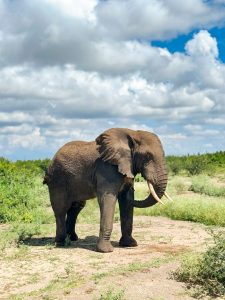
Of the 350,000 African elephants in Africa, approximately 7000 are in Uganda. You will most likely find them in Kidepo Valley National Park, Murchison Falls National Park, Queen Elizabeth National Park, and Semliki National Park (both forest and bush elephants). Also not so common, elephants can also be seen in Bwindi Impenetrable and Kibale National Parks, where the forest elephants are found.
Known as the largest land mammals on Earth, elephants are interesting to see during Uganda Big Five safaris, where your breath will be taken away by their dust baths or young calves playing in the mud. With a standing height of 3 meters and a weight of up to 6000 kilograms (average), male elephants can live up to 70 years.
These Big mammals communicate through different ways that include body language, trumpet calls, scent, and touch. Interestingly, they also communicate through seismic signals (sounds created through vibrations in the ground, which they can detect through their bones).
Elephants are known for having incredible memories, aided by the large and dense temporal lobe (the area of the brain associated with memory), hence makes it difficult for them to forget easily.
African buffaloes
Also referred to as “Cape buffaloes”, the African buffaloes are undeniably the least glamorous of the Big Five Game, but can surprisingly be very dangerous. Rangers usually refer to them as the “widowmaker” or the “Black death”, and known for killing more hunters than any other wildlife species.
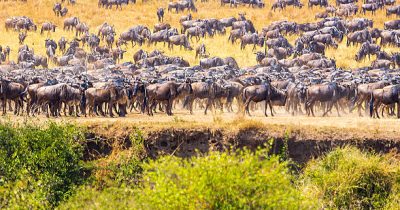
Few travelers will book a Uganda Big Five safari based on the likelihood of seeing Cape buffaloes, but there are places where you are guaranteed to see them. Unforgettable encounters, fights between lone “Bachelor” buffaloes, but if you wish to see large herds, then consider visiting Kidepo Valley, Murchison Falls, Queen Elizabeth, and Lake Mburo National Parks.
When to see the Big Five Game in Uganda?
Knowing the best time to see the Big Five Game will help you get the most out of your Uganda Big Five safari because different seasons provide unique game viewing experiences.
The dry season (June to October and December to February) in the savannah safari destinations is widely considered the best time to go on a Uganda Big Five safaris. With reduced rainfall levels, the vegetation thins out, and water sources become scarce. This draws animals to waterholes where they can be easily spotted.
The wet season (March to May, and November) brings verdant vegetation and an influx of migratory bird species, hence turning the National Parks into lush paradises. However, the Big Five Game is more dispersed, and sightings can be more challenging. Even with this, the wet season is a wonderful time to visit Uganda for birding and witnessing the arrival of newborn wildlife species.