14 Days Budongo Chimps and Rwenzori Trek
Embark on an extraordinary 14 Days Budongo Chimps and Rwenzori Trek that weaves together Uganda’s most iconic wildlife experiences with an ascent of Africa’s third-highest mountain. This is an adventure of remarkable contrasts and cumulative power – from intimate encounters with endangered rhinos and chimpanzees in their forest habitats, to standing atop Margherita Peak at 5,109 meters where the world stretches beneath your feet, to face-to-face moments with mountain gorillas in misty Bwindi.
You’ll traverse from lowland savannas to equatorial rainforests to alpine zones, experiencing nearly every African ecosystem within two weeks. This is not a simple safari or a simple trek; it’s a comprehensive African expedition that tests your body, expands your spirit, and leaves you transformed by the wildlife and mountains of Uganda.
Safari Summary of Your 14 Days Budongo Chimps and Rwenzori Trek
- Day 1: Transfer to Ziwa Rhino Sanctuary
- Day 2: Rhino Tracking and Chimpanzee Tracking in Budongo Forest
- Day 3: Game Drive and Boat Cruise in Murchison Falls National Park
- Day 4: Transfer to Kasese
- Day 5: Nyakalengija (1,600m). Hike to Nyabitaba Hut (2,650m).
- Day 6: Trek to John Matte Hut (3,505m).
- Day 7: Climb to Bujuku Hut (3,962m)
- Day 8: Hike to Elena Hut (4,541m)
- Day 9: Climb to Margherita Peak (5,109m) and descend to Kitandara Hut (4,027m).
- Day 10: Trek down to Guy Yeoman Hut (3,505m).
- Day 11: Descend through the bamboo forests back to the Nyakalengija Gate
- Day 12: Transfer to Bwindi National Park
- Da 13: Gorilla Trekking and Transfer to Lake Bunyonyi
- Day 14: Transfer to Entebbe or Kigali
Detailed Itinerary
Day 1: Transfer to Ziwa Rhino Sanctuary
Your 14 Days Budongo Chimps and Rwenzori Trek begins with a transfer north from Kampala toward Ziwa Rhino Sanctuary, one of Uganda’s most important conservation initiatives. The drive takes you through Uganda’s changing landscape – from urban sprawl to farmland to increasingly wild terrain. Ziwa Sanctuary represents hope in conservation, a place where one of Africa’s most endangered species is being brought back from the brink of extinction.
Arriving at your lodge near the sanctuary, you settle in with anticipation. The rhino project here has successfully reintroduced these magnificent creatures to Uganda after decades of absence due to poaching. Tomorrow you’ll be among the handful of people who see them in the wild. The sanctuary’s story is one of determination and conservation success – a reminder that even the most dire situations can be reversed with commitment and effort.
Day 2: Rhino Tracking and Chimpanzee Tracking in Budongo Forest
Your morning begins before dawn with a guided walking safari through Ziwa Rhino Sanctuary. Your tracker moves quietly through grasslands, reading signs that betray the presence of these massive creatures. Then, emerging through scattered vegetation, you encounter a rhino or rhinos, their prehistoric forms and powerful presence striking something primal within you. These are the rarest of East Africa’s megafauna, and standing near them, you understand viscerally why conservation matters.
By afternoon, you track chimpanzees in Budongo Forest. This ancient forest is one of Uganda’s most intact rainforests and home to one of the country’s largest chimpanzee populations.
Day 3: Game Drive and Boat Cruise in Murchison Falls National Park
Today brings a game drive through portions of Murchison Falls National Park, Uganda’s oldest and most iconic protected area. Your guide navigates the park’s varied habitats, and the wildlife reveals itself in layers – elephants moving through grasslands, buffalo in powerful herds, antelope species grazing peacefully, and giraffes extending their impossibly long necks to reach acacia leaves. The birdlife here is extraordinary, and your guide points out species you’ve never seen before.
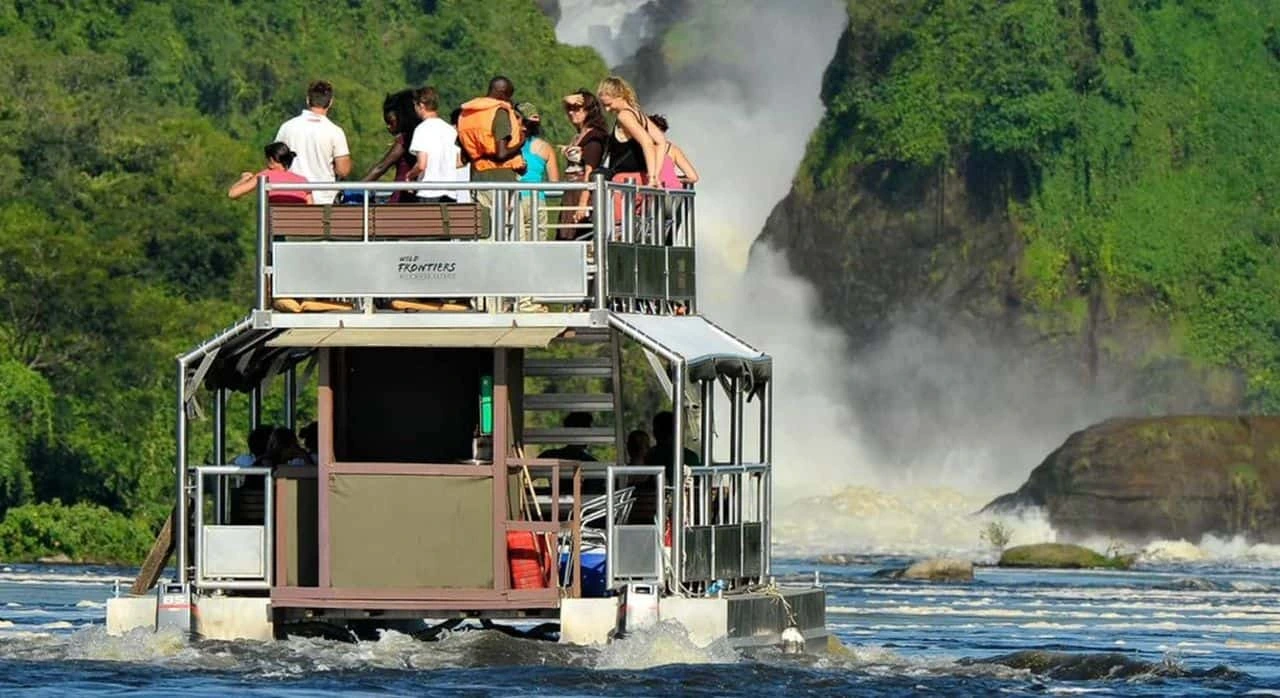
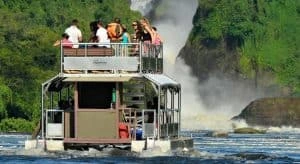
In the afternoon, you board a boat to cruise along the Nile River toward the base of Murchison Falls. As you approach, the sound of falling water grows louder, millions of gallons of the Nile River compressed through a narrow gorge, exploding downward in a breathtaking curtain of white water. The power is overwhelming, the beauty indescribable. Hippos surface in the river, crocodiles bask on banks, and the entire ecosystem seems concentrated along this legendary waterway.
Day 4: Transfer to Kasese
Today is a transition day as you transfer southward toward Kasese, a small town at the base of the Rwenzori Mountains. The drive takes you through changing landscapes, from the savanna toward more forested terrain as elevation gradually increases. The mountains grow more prominent on the horizon, their peaks visible on clear days, massive and commanding. You arrive in Kasese as evening approaches, resting and preparing for the mountain trek that begins tomorrow. The air is noticeably cooler, and the anticipation of climbing Africa’s third-highest mountain builds with each passing hour.
Day 5: Nyakalengija to Nyabitaba Hut
Your Rwenzori adventure officially begins at Nyakalengija, a modest trailhead village at 1,600 meters. Before dawn, your mountain guide briefs you on the week ahead: a challenging trek through multiple ecosystems that will test your body and expand your perspective. The trail immediately enters thick rainforest, a verdant world of towering trees, hanging vines, and the calls of birds and primates echoing through the canopy.
The hike to Nyabitaba Hut gains elevation gradually through dense forest, climbing over 1,000 meters. The forest here is alive in ways difficult to comprehend. Moisture drips from every leaf, moss covers trees like velvet, and the air itself feels pregnant with life. Your guide points out bird species and forest life as you ascend. Arriving at Nyabitaba Hut at 2,650 meters, you’ve climbed significantly but are still surrounded by forest. The hut offers shelter, and the porters have managed supplies through challenging terrain. You rest knowing that tomorrow’s elevation gain will be steeper.
Day 6: Trek to John Matte Hut
Day six steepens considerably as you push toward John Matte Hut at 3,505 meters. The forest canopy begins to lower, vegetation changes noticeably, and the air becomes cooler and damper. The trail becomes increasingly muddy as elevation increases, the forest’s moisture creating conditions where water never quite drains completely.
Then comes the Bigo Bog, a legendary section of the Rwenzori trek where the trail becomes a sludgy, waterlogged maze. Your boots sink into mud that seems bottomless, and every step requires effort. But this challenging section is quintessentially Rwenzori, beautiful in its wildness, transformative in how it tests your determination. Groundsel – strange, alien-looking plants that only grow at high African elevations – begin to appear. Arriving at John Matte Hut, you’re muddy and tired but exhilarated by the climb and the transformation of the landscape.
Day 7: Climb to Bujuku Hut Near Bujuku Lake
The trek to Bujuku Hut at 3,962 meters continues the elevation gain and ecological transition. The forest has largely given way to alpine meadows interspersed with rocky terrain. The vegetation becomes increasingly sparse – low shrubs and herbaceous plants defined by survival at altitude.
Bujuku Lake appears before you as a stunning alpine jewel of clear, cold water reflecting the rocky peaks above. The lake sits in a glacial cirque, surrounded by cliffs and peaks that suddenly reveal the true scale of these mountains. The air is thin now, and your breathing has become more labored, but the views make every difficult step worthwhile. The beauty here is stark and magnificent. There’s a purity to the landscape that seems to exist at the roof of the world.
Day 8: Hike to Elena Hut in the Rocky Alpine Zone
Today’s trek enters true alpine terrain, rocky, exposed, and otherworldly. The elevation gain to Elena Hut at 4,541 meters is approximately 600 meters, but it feels longer as the air becomes noticeably thinner. The landscape is now predominantly rock and hardy alpine vegetation, with little protection from wind or elements.
The trail ascends through rocky terrain where each step must be carefully placed. Glaciers and permanent snow fields become visible – remnants of the Rwenzori’s glaciated past, shrinking year by year as climate change takes its toll. Elena Hut sits at the edge of the rocky alpine zone, exposed to the elements but positioned perfectly for tomorrow’s summit push. The hut is a basic shelter more than comfort – but at this elevation, it’s a sanctuary. The night is cold and clear, and stars visible from this elevation seem impossibly bright.
Day 9: Summit Day – Margherita Peak and Descent to Kitandara Hut
An alpine start – perhaps 1:00 or 2:00 AM – sees you departing Elena Hut with headlamps illuminating the rocky terrain. The final ascent to Margherita Peak at 5,109 meters is approximately 600 meters of elevation gain, but the altitude makes every meter feel significant. The climb is rocky and steep, requiring scrambling where hands are often used alongside feet.
The air grows progressively thinner, and breathing becomes deliberate and focused. But with each meter gained, the view expands. First, the peaks of Rwenzori reveal themselves in pre-dawn light. Then, as the sun rises, the landscape expands exponentially – you can see across Uganda, across the Democratic Republic of Congo, across the entire Rwenzori massif. You stand on Margherita Peak, the third-highest mountain in Africa, in the thin alpine air where few humans ever venture. The achievement is profound – not just the physical summit, but the journey it required.
You descend back to Elena Hut and continue down to Kitandara Hut at 4,027 meters. The descent is easier on the legs but harder on the knees and feet. Arriving at Kitandara Hut, you rest knowing that tomorrow begins the gentle descent back toward the forest and lower elevations.
Day 10: Trek Down to Guy Yeoman Hut
The descent continues as you trek from Kitandara Hut down to Guy Yeoman Hut at 3,505 meters. The elevation loss – over 500 meters – is felt in every step downward, but it also brings warmer air and denser vegetation. The alpine meadows give way gradually to shrubby terrain, and the ecosystem transitions visibly as you descend. Guy Yeoman Hut marks a transition point in your journey; you’re returning toward the forest zone, toward lower elevations where oxygen is more abundant, and breathing feels natural again.
Day 11: Descend Through Bamboo Forests Back to Nyakalengija Gate
Your final day of mountain trekking begins at Guy Yeoman Hut and descends through a landscape that gradually transforms back into a bamboo forest and then equatorial rainforest. The descent covers approximately 1,900 meters of elevation loss back to Nyakalengija – a significant descent that taxes your knees and feet but brings you back to the world you left six days ago.
The bamboo forest section is particularly striking – towering bamboo stalks create a tunnel-like passage. Birds call from the canopy, primates move through the undergrowth, and the smell of the rainforest grows stronger as you descend. Arriving at Nyakalengija, you’ve completed a week-long mountain trek that has tested your body and expanded your spirit. The view back up at the mountains you’ve climbed is awe-inspiring – the peaks seem impossibly high, the journey you’ve just completed almost unbelievable in its accomplishment.
Day 12: Transfer to Bwindi National Park
After a rest day at Nyakalengija, you depart for Bwindi Impenetrable National Park, one of the world’s most biodiverse forests. The drive takes you through changing landscapes from mountain foothills toward increasingly forested terrain. The landscape becomes increasingly hilly and forested, and anticipation builds knowing that one of your journey’s most extraordinary encounters awaits.
You arrive at your lodge nestled within or near the forest, where the sounds of the rainforest – bird calls, rustling leaves, the calls of colobus monkeys fill the air with the promise of tomorrow’s greatest adventure.
Day 13: Gorilla Trekking and Transfer to Lake Bunyonyi
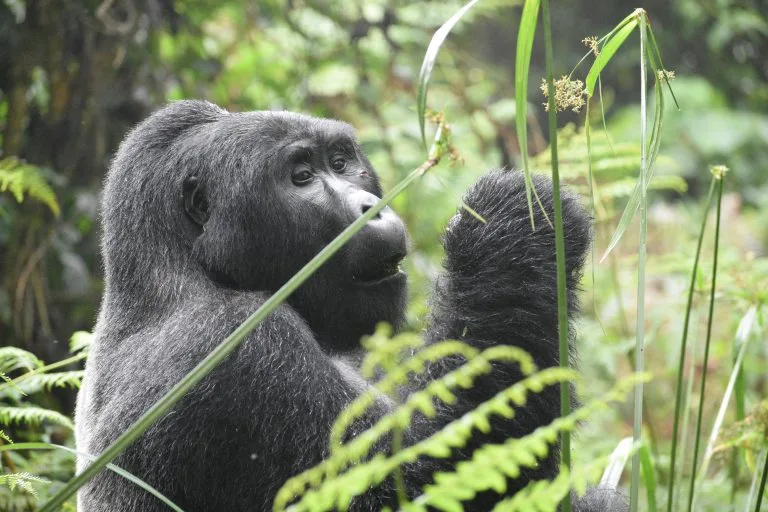
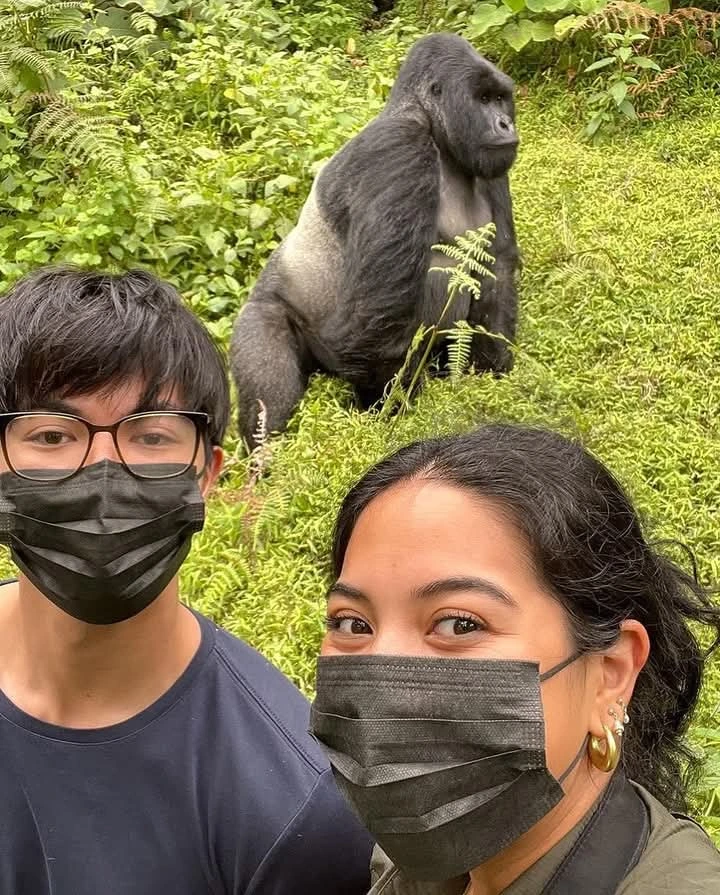
After breakfast, you will drive to the park headquarters and join other trackers. Guides and rangers lead you into the forest in search of the gorillas. Upon meeting them, you will spend one hour in their presence. Take as many photos as your camera can store. Break for lunch before hitting the road to Lake Bunyonyi. Upon arrival, check in to your lodge for dinner and overnight.
Day 14: Transfer to Entebbe or Kigali
Your final morning offers time to reflect on the past two weeks. A leisurely breakfast at Lake Bunyonyi allows you to process the journey’s extraordinary highlights. The drive to Entebbe or Kigali takes you through Uganda’s diverse landscapes one final time – from forested highlands to rolling hills to the approach of either capital city. This marks the end of your 14 Days Budongo Chimps and Rwenzori Trek with Uganda’s best gorilla trekking company.