11 Days Rwenzori Trek and Kyambura Chimpanzees Safari
Embark on an extraordinary 11 Days Rwenzori Trek and Kyambura Chimpanzees Safari that merges two of Africa’s most transformative experiences: summiting the legendary Rwenzori Mountains, the “Mountains of the Moon,” and encountering Africa’s most remarkable wildlife. This is an adventure of profound contrasts from the thin air of Africa’s third-highest peak at 5,109 meters, where alpine vistas stretch across borders, to the lush rainforests where chimpanzees and gorillas move through their ancestral domains.
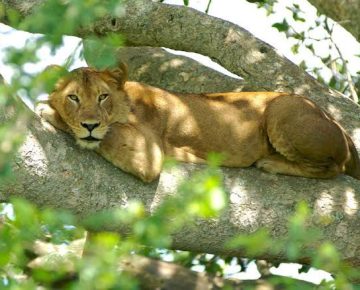
You’ll traverse elevations that span Africa’s entire ecosystem spectrum, from equatorial forest through bamboo thickets to rocky alpine zones, then descend into savannas where lions rest in acacia trees. This 11 Days Rwenzori Trek and Kyambura Chimpanzees Safari journey tests your body, expands your spirit, and leaves you forever changed by mountains and wildlife that transcend the ordinary.
Safari Summary
- Day 1: Nyakalengija (1,600m). Hike to Nyabitaba Hut (2,650m).
- Day 2: Trek to John Matte Hut (3,505m).
- Day 3: Climb to Bujuku Hut (3,962m)
- Day 4: Hike to Elena Hut (4,541m)
- Day 5: Climb to Margherita Peak (5,109m) and descend to Kitandara Hut (4,027m).
- Day 6: Trek down to Guy Yeoman Hut (3,505m).
- Day 7: Descend through the bamboo forests back to the Nyakalengija Gate
- Day 8: Chimpanzee Tracking in Kyambura Gorge and Boat Cruise on Kazinga Channel
- Day 9: Ishasha Sector Game Drive and Transfer to Bwindi National Park
Day 10: Gorilla Trekking and Transfer to Lake Mburo National Park - Day 11: Morning Nature Walk and Transfer to Entebbe
Detailed Itinerary
Day 1: Nyakalengija and Hike to Nyabitaba Hut
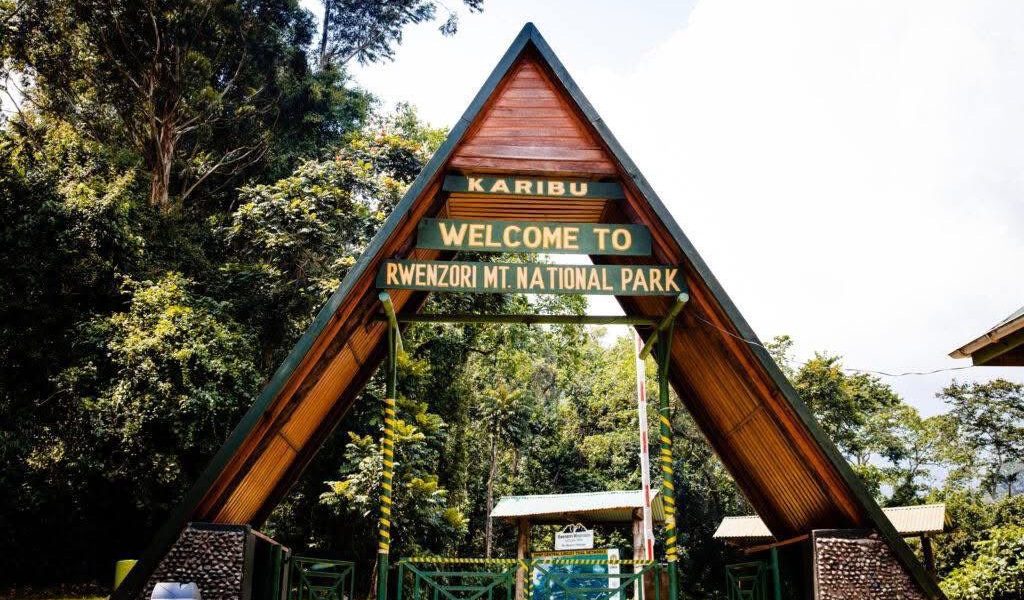
Your 11 Days Rwenzori Trek and Kyambura Chimpanzees Safari begins at Nyakalengija, a modest trailhead village sitting at 1,600 meters, where the air is cool, and the forest begins its ascent. Before dawn, your experienced mountain guide briefs you on the journey ahead, seven days of trekking that will take you from equatorial rainforest through alpine meadows to the roof of Uganda. The weight of your pack settles onto your shoulders as you step onto the trail, immediately enveloped by thick forest.
The initial hike to Nyabitaba Hut gains elevation gradually through dense rainforest, a verdant world of towering trees, hanging vines, and the calls of birds and primates echoing through the canopy. The forest here is alive in ways difficult to comprehend. Moisture drips from every leaf, moss covers the trees like velvet, and the air itself feels pregnant with life. Your guide points out bird species, plant life, and the evidence of forest animals – a trail of elephant dung, the calls of colobus monkeys above. As you ascend, the forest gradually transitions, the vegetation shifting subtly as altitude increases.
Arriving at Nyabitaba Hut at 2,650 meters, you’ve climbed over 1,000 meters but are still surrounded by forest. The hut offers shelter and a camp where porters have prepared your dinner. The air is noticeably cooler now, and as darkness falls, the sounds of the forest change, with different birds calling, insects singing their evening chorus. You rest knowing that tomorrow’s elevation gain will be steeper, and the forest will gradually give way to higher alpine zones.
Day 2: Trek to John Matte Hut and Cross the Bigo Bog
Day two’s trek steepens considerably as you push toward John Matte Hut at 3,505 meters. The forest canopy begins to lower, and vegetation changes noticeably. Trees become smaller, mosses thicker, the air cooler and damper. The trail becomes increasingly muddy as elevation increases, the forest’s moisture creating conditions where water never quite drains completely.
Then comes the Bigo Bog, a legendary section of the Rwenzori trek where the trail becomes a sludgy, waterlogged maze. Your boots sink into mud that seems bottomless, and every step requires effort and careful balance. Porter paths have created networks of routes through the bog, and your guide navigates these with practised knowledge. The bog is quintessentially Rwenzori, beautiful in its wildness, challenging in its demands, and transformative in how it tests your determination. The vegetation here is stunted and hardy, adapted to constant wetness and cold. Groundsel’s strange, alien-looking plants that only grow at high African elevations begin to appear, their architectural forms unlike anything in lower forests.
Arriving at John Matte Hut, you’re muddy, tired, and exhilarated. The elevation gain today was significant – nearly 900 meters, and your body feels it. But the hut offers warmth and food, and the view from your elevation reveals the landscape you’ve climbed through. Tomorrow, you ascend toward even higher terrain, toward the alpine zone proper.
Day 3: Climb to Bujuku Hut Near Bujuku Lake
The trek to Bujuku Hut at 3,962 meters continues the elevation gain and ecological transition. The forest has largely given way to alpine meadows interspersed with rocky terrain. The vegetation becomes increasingly sparse – low shrubs, herbaceous plants, and the spectacular groundsels that seem to define the Rwenzori alpine ecosystem.
Bujuku Lake appears before you as a stunning alpine jewel of clear, cold water reflecting the rocky peaks above. The lake sits in a glacial cirque, surrounded by cliffs and peaks that suddenly reveal the true scale of these mountains. The air is thin now, and your breathing has become more laboured, but the views make every difficult step worthwhile. The beauty here is stark and magnificent. There’s a purity to the landscape, a sense of standing at the roof of the world.
Bujuku Hut, situated near this legendary lake, becomes your home for the night. Porters have managed to transport supplies here through terrain that seems nearly impossible, and hot food and shelter await. The temperature has dropped significantly – at nearly 4,000 meters, nights are cold, and layers become essential. You rest knowing that tomorrow brings the push toward the summit zone, toward Elena Hut at 4,541 meters, and that the day after tomorrow is summit day itself.
Day 4: Hike to Elena Hut in the Rocky Alpine Zone
Today’s trek enters true alpine terrain, rocky, exposed, and otherworldly. The elevation gain to Elena Hut at 4,541 meters is approximately 600 meters, but it feels longer as the air becomes noticeably thinner and every breath requires conscious effort. The landscape is now predominantly rock and hardy alpine vegetation, with little protection from wind or elements.
The trail ascends through rocky terrain where each step must be carefully placed. Glaciers and permanent snow fields become visible – remnants of the Rwenzori’s glaciated past, shrinking year by year as climate change takes its toll. The sight of these permanent ice fields at the equator is surreal, a reminder of the mountain’s unique position and the changing climate affecting these ancient peaks.
Elena Hut sits at the edge of the rocky alpine zone, exposed to the elements but positioned perfectly for tomorrow’s summit push. The hut is basic – shelter more than comfort – but at this elevation, it’s a sanctuary. The air is thin enough that breathing feels like work even at rest, and acclimatisation becomes critical. Your guide monitors everyone carefully for signs of altitude sickness, ensuring that the push toward Margherita Peak tomorrow is manageable. The night is cold and clear, and stars visible from this elevation seem impossibly bright and numerous. You’re at nearly 4,500 meters – higher than any mountain in North America except Denali -, and tomorrow you climb higher still.
Day 5: Summit Day – Margherita Peak and Descent to Kitandara Hut
This is the day you’ve been building toward. An alpine start – perhaps 1:00 or 2:00 AM – sees you departing Elena Hut with headlamps illuminating the rocky terrain. The final ascent to Margherita Peak at 5,109 meters is approximately 600 meters of elevation gain over roughly four hours, but the altitude makes every meter feel significant.
The climb is rocky and steep, requiring scrambling over terrain where hands are often used alongside feet. The air grows progressively thinner, and breathing becomes deliberate and focused. But with each meter gained, the view expands. First, the peaks of Rwenzori reveal themselves in pre-dawn light. Then, as the sun rises, the landscape expands exponentially on clear mornings, and you can see across Uganda, across the Democratic Republic of Congo, across the entire Rwenzori massif.
Then you stand on Margherita Peak, the third-highest mountain in Africa. You’re above 5,000 meters, in the thin alpine air where few humans ever venture. The view encompasses the curvature of the Earth itself and the vastness of the continent spread below. The achievement is profound, not just the physical summit, but the journey it required, the mountains you’ve climbed, the forest you’ve traversed, the altitude you’ve conquered. For many, this is a life-defining moment.
But the climb isn’t complete until you’re down. You descend back to Elena Hut and continue down to Kitandara Hut at 4,027 meters, a shorter day by distance but emotionally and physically complete. The descent is easier on the legs but harder on the knees and feet. Arriving at Kitandara Hut, you rest knowing that tomorrow begins the gentle descent back toward forest and civilisation.
Day 6: Trek Down to Guy Yeoman Hut
The descent begins in earnest today as you trek from Kitandara Hut down to Guy Yeoman Hut at 3,505 meters. The elevation loss of over 500 meters is felt in every step downward, but it also brings warmer air and denser vegetation. The alpine meadows give way gradually to shrubby terrain, and the ecosystem transitions visibly as you descend.
Guy Yeoman Hut marks a transition point in your journey; you’re returning toward the forest zone, toward lower elevations where oxygen is more abundant, and breathing feels natural again. The hut sits in a landscape of transition, where the harsh alpine zone gives way to more hospitable terrain. The porters have managed supplies here through terrain that remains challenging but less extreme than the upper mountain. You rest tonight with the knowledge that tomorrow brings final descent and the return to the forest you left six days ago.
Day 7: Descend Through Bamboo Forests Back to Nyakalengija
Your final day of mountain trekking begins at Guy Yeoman Hut and descends through a landscape that gradually transforms back into bamboo forest and then equatorial rainforest. The descent covers approximately 1,900 meters of elevation loss back to Nyakalengija at 1,600 meters, a significant descent that taxes your knees and feet, but brings you back to the world you left a week ago.
The bamboo forest section is particularly striking; towering bamboo stalks create a tunnel-like passage, and the forest here has its own character distinct from both the alpine zones above and the lowland forest below. Birds call from the canopy, primates move through the undergrowth, and the smell of the rainforest grows stronger as you descend.
Arriving at Nyakalengija, you’ve completed a week-long mountain trek that has tested your body and expanded your spirit. The view back up at the mountains you’ve climbed is awe-inspiring. The peaks seem impossibly high, the journey you’ve just completed almost unbelievable in its accomplishment. You have a rest day here to recover, resupply, and prepare for the safari portion of your adventure that awaits.
Day 8: Chimpanzee Tracking in Kyambura Gorge and Boat Cruise on Kazinga Channel
Refreshed after a day of recovery, you depart for Kyambura Gorge in Queen Elizabeth National Park, a dramatic landscape where steep-sided valleys hide some of Uganda’s most accessible chimpanzee populations. Your guide leads you down into the gorge’s depths, the landscape shifting from grassland to dense forest as elevation decreases.
The gorge itself is a remarkable and hidden world of thick vegetation, water sources, and the sounds of primates echoing off rocky walls. The chimpanzee tracking requires patience and quiet movement, reading signs, and listening for calls that betray the presence of habituated families. Then, emerging through vegetation, you encounter them – chimpanzees moving through their forest, feeding, vocalising, their intelligence and humanity unmistakable. The power of this encounter after days of high-altitude climbing grounds you in the living world.
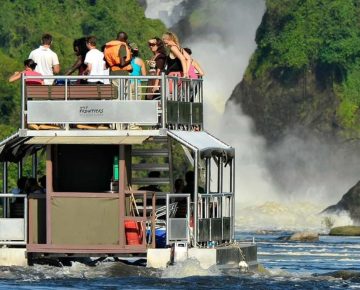
In the afternoon, you board a boat for a cruise on the Kazinga Channel, that legendary 32-kilometre waterway connecting two of Queen Elizabeth’s largest lakes. The channel is a gathering place for Africa’s mega-fauna – hippos emerging from water, crocodiles basking on banks, elephants wading to drink, buffalo herds approaching shorelines. The abundance is staggering, and after days in the thin air of the mountains, this profusion of wildlife feels like stepping into another world entirely.
Day 9: Ishasha Sector Game Drive and Transfer to Bwindi National Park
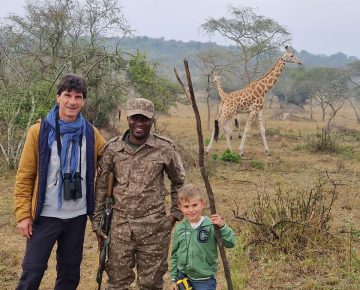
This morning brings a game drive through the Ishasha Sector of Queen Elizabeth, where the legendary tree-climbing lions make their home. Your guide navigates golden grasslands and scattered woodlands, searching the acacia trees for these remarkable predators. The behaviour – lions resting in branches – is rare and remarkable, an adaptation to unique ecological conditions in this corner of Africa.
Whether you encounter the tree-climbing lions or not, the game drive reveals the varied wildlife of Queen Elizabeth – elephants, buffalo, antelope species, and birdlife of remarkable diversity. The landscape here, rolling and scenic, provides stunning views of the park’s varied habitats.
By afternoon, you transfer southward toward Bwindi Impenetrable National Park, one of the world’s most biodiverse forests. The landscape transitions from savanna to increasingly forested terrain, the elevation rising as you approach the park’s boundaries. Arriving as evening descends, you settle into your lodge where the sounds of the rainforest – bird calls, rustling leaves, the calls of colobus monkeys – fill the air with anticipation for tomorrow’s greatest adventure.
Day 10: Gorilla Trekking and Transfer to Lake Mburo National Park
Today is a gorilla trekking day. After breakfast, you drive to the park headquarters for a briefing. You enter the forest in search of the giant apes. Meeting a gorilla family is an amazing experience. A massive silverback male sits peacefully, his muscular frame commanding respect, his thoughtful expression reflecting intelligence and dignity. Females move with grace, tending to their young. Juvenile gorillas play and wrestle. The intimacy of being in their presence, witnessing their behaviour, seeing the unmistakable intelligence in their eyes – this transforms understanding into profound respect. For your hour-long encounter, time suspends.
Following this transcendent experience, you transfer to Lake Mburo National Park, arriving as the afternoon light turns golden.
Day 11: Morning Nature Walk and Transfer to Entebbe
Your final morning of 11 Days Rwenzori Trek and Kyambura Chimpanzees Safari begins with a guided nature walk through Lake Mburo’s varied habitats. The park’s concentrated wildlife and remarkable birdlife reveal themselves as the day awakens herds of impala and zebra grazing, buffalo moving with confidence, kingfishers diving brilliantly, and fish eagles calling from distant trees.
The walk is unhurried, reflective – a chance to process the extraordinary experiences of the past eleven days. From standing at 5,109 meters on Margherita Peak, surveying the landscape from the roof of Uganda, to standing face-to-face with mountain gorillas in their forest sanctuary, to encountering the abundance of wildlife in Queen Elizabeth’s ecosystems – this journey has spanned elevation zones, ecological systems, and emotional territories.
By mid-morning, you transfer toward Entebbe, travelling through Uganda’s diverse landscapes one final time. You depart transformed. The Rwenzori Mountains tested your physical limits and expanded your perspective. The chimpanzees and gorillas revealed intelligence and dignity that challenge how we see our species’ place in the natural world. The wildlife abundance of Queen Elizabeth’s ecosystems reminded you that Africa still harbours wild places of staggering beauty. You leave not just as a trekker or a safari tourist, but as someone who has touched both the heights of mountains and the depths of rainforests, forever changed by the Rwenzori and the remarkable creatures that share these wild African lands.