
Accessing Uganda Gorillas from Rwanda Airport
For decades, the dream of coming face-to-face with a Mountain Gorilla in the wild was synonymous with a long, arduous overland journey. While Uganda remains the premier destination for gorilla tourism, boasting more than half of the world’s remaining population of these majestic primates, the logistics of getting there have historically involved a lengthy drive from Entebbe International Airport. However, the rise of regional travel infrastructure has opened a “back door” that is rapidly becoming the preferred route for savvy travellers: visiting Uganda gorillas via Kigali International Airport in Rwanda.
This route, often referred to as the “Kigali Shortcut,” offers a seamless, scenic, and time-efficient entry point into the heart of the gorilla highlands. It transforms a logistical challenge into a delightful part of the adventure, allowing travellers to maximise their time with the gorillas and minimise their time on the tarmac.

Why the Kigali Route Makes Sense
To understand the appeal of flying into Kigali, one must look at the geography of the region. Entebbe, Uganda’s primary international airport, serves the capital city of Kampala. From Entebbe, driving to the southern sectors of Bwindi Impenetrable National Park can take anywhere from 9 to 10 hours. While the drive offers a cross-section of Uganda, it consumes two full days of a typical itinerary (one day there, one day back).
In contrast, Kigali International Airport is located mere kilometres from the northern border of Uganda. Specifically, it is situated close to the Cyanika and Gatuna border posts. Flying into Kigali allows visitors to access the southern gorilla trekking sectors of Bwindi and Mgahinga Gorilla National Park via a drive that takes only 3 to 4 hours. This efficiency saves an entire day of travel, reduces fatigue, and lowers the overall cost of internal transport.
Furthermore, Kigali is a regional hub serviced by major international carriers, including Qatar Airways, Turkish Airlines, Ethiopian Airlines, KLM, and Brussels Airlines, offering excellent connectivity from Europe, the Middle East, and Asia.
The Gateway Parks: Bwindi and Mgahinga
Using the Kigali route grants access to two of Uganda’s most treasured conservation areas. The most direct route usually leads to the southern sectors of Bwindi Impenetrable National Park (the Nkuringo and Rushaga sectors) or the adjacent Mgahinga Gorilla National Park.
Bwindi Impenetrable National Park is a UNESCO World Heritage Site and is famous for its dense, montane rainforest. It is home to roughly half of the world’s mountain gorilla population. The southern sectors of Nkuringo and Rushaga are particularly accessible from Rwanda. Nkuringo is renowned for its challenging but rewarding terrain and spectacular views of the Virunga Volcanoes, while Rushaga is famous for having the highest number of habituated gorilla families in the entire park, offering greater permit availability.
Mgahinga Gorilla National Park, while smaller, is part of the greater Virunga ecosystem shared with Rwanda and DR Congo. It is home to the Nyakagezi gorilla group, a family that is historically mobile but has now settled comfortably in the park. Mgahinga offers a distinct trekking experience, often set against the dramatic backdrop of three extinct volcanoes. It is also the only place in Uganda where one can track the endangered Golden Monkey, a vibrant primate species found only in the Albertine Rift.
Scenic Landscapes and Cultural Encounters
The drive from Kigali to the Ugandan parks is not merely a transfer; it is a visual feast. The journey begins in the orderly, hilly streets of Kigali. As you leave the city limits, you enter the “Land of a Thousand Hills.” The road winds through endlessly terraced landscapes of steep, green hillsides.
Travellers pass through small rural towns where life moves at a gentle pace. You will see farmers tending to their crops, children walking to school in uniforms, and women carrying baskets on their heads. The scenery is characterised by eucalyptus trees, tea plantations that carpet the valleys in neat geometric patterns, and the misty peaks of the Virunga volcanoes looming in the distance.
The primary border crossing used for this route is the Cyanika Border (for those heading to Nkuringo/Mgahinga) or the Gatuna Border (for those heading to Ruhija or Buhoma sectors). The border formalities are generally straightforward. On the Rwandan side, you clear immigration, walk across the no-man’s-land, and enter Uganda. Here, you present your passport and visa documentation. The border officials are accustomed to tourists, and the process is usually efficient.
Visa Logistics: The East African Tourist Visa
One of the key facilitators of this route is the East African Tourist Visa (EATV). Priced at $100, this single multiple-entry visa is valid for 90 days and allows travel to Rwanda, Kenya, and Uganda. For a traveller flying into Kigali with the intention of trekking in Uganda and perhaps flying out of Nairobi or returning to Kigali, this visa is an excellent administrative tool.
If you do not have an EATV, Uganda offers a visa-on-arrival ($50) or an e-visa system. It is crucial to check the latest visa regulations regarding Yellow Fever vaccination cards, which are mandatory for entry into Uganda for most travellers. Your tour operator will usually guide you on these requirements to ensure a smooth crossing.
Transport Options: Self-Drive vs. Private Transfer
While the adventurous might consider self-driving to Uganda, the route from Kigali in Rwanda to Bwindi for Gorillas is not for the faint of heart. Although the main roads are paved, the final stretches into the national parks are often steep, narrow, and winding, particularly the infamous “Nkuringo Switchback,” which challenges even the most experienced drivers. Additionally, navigating border formalities and ensuring you have the correct local currency can be stressful.
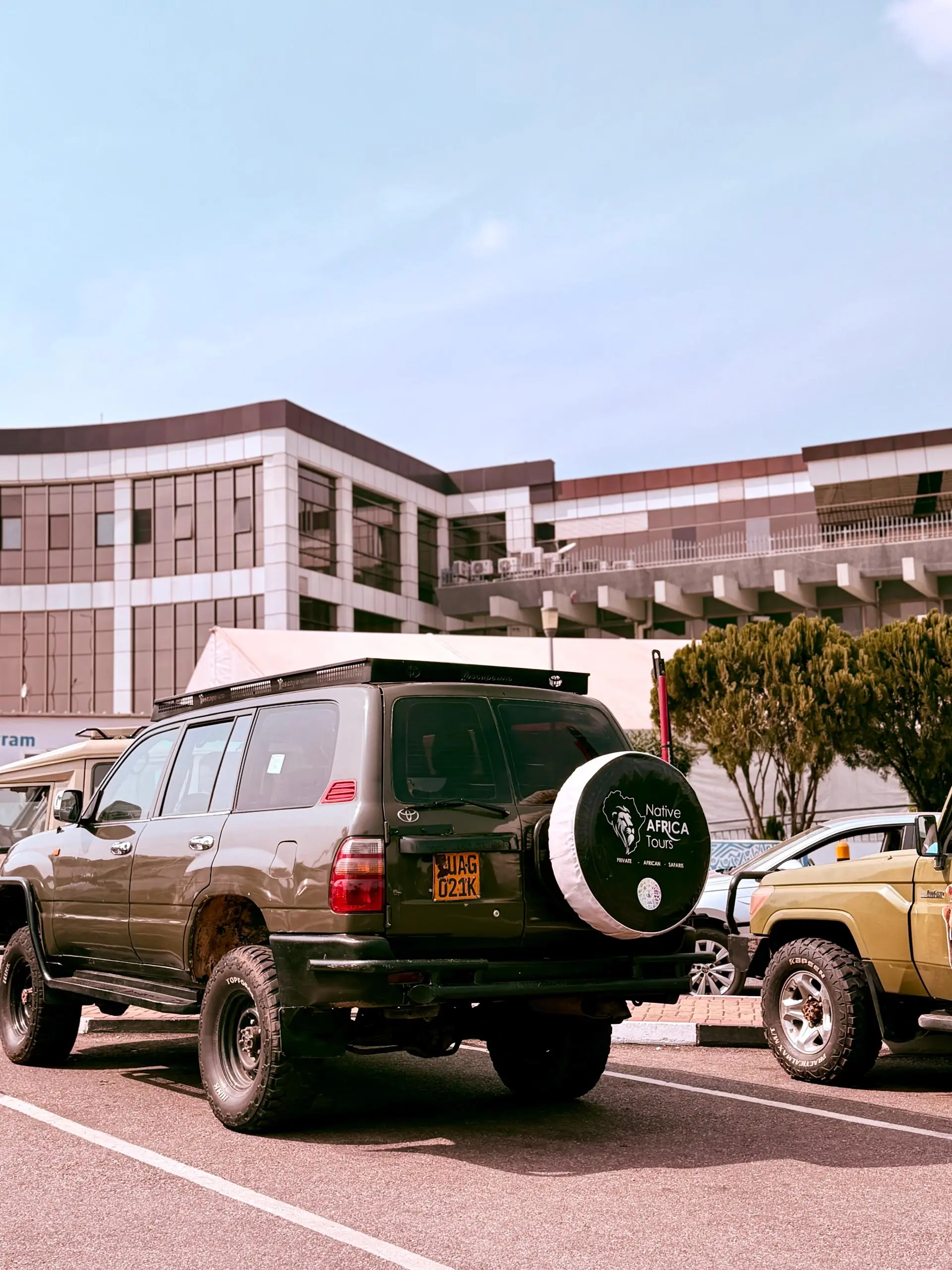
Most travellers opt for a private transfer arranged by a local tour operator like Native Africa Tours. This service usually involves a 4×4 Land Cruiser with a professional driver-guide. The driver handles the border paperwork, knows the best spots for a lunch stop, and ensures you arrive at your lodge safely. The comfort of a 4×4 is essential, especially during the rainy seasons when the dirt roads in the parks can become muddy and slippery.
Practical Tips for the Journey
When planning this trip, preparation is key. The roads in the parks are rough, so motion sickness medication is advised if you are prone to it. The altitude is high (lodges can be over 2,000 meters above sea level), so hydration is essential. While Uganda is warmer than Rwanda generally, the mornings in the mountains are chilly, and it rains year-round. Pack layers, waterproof hiking boots, and garden gloves for grabbing onto vegetation during the trek.
Also, ensure you have printed copies of your gorilla permit, as these will be checked at the park entrance. Communication is generally in English, though the local guides in Uganda are multilingual.
Conclusion
Accessing Uganda gorillas from Kigali International Airport in Rwanda is more than just a travel hack; it is a revelation. It opens up the southern sectors of Bwindi and the wonders of Mgahinga to travellers who may have been deterred by the long drive from Entebbe. It offers a perfect blend of convenience and adventure, allowing the journey to be just as beautiful as the destination.
For those seeking the ultimate wildlife encounter of Uganda Gorillas without the logistical headache, the Kigali airport in Rwanda is the gateway to the jungle. It provides a streamlined, scenic, and sensible path to one of the most profound wildlife experiences on Earth: staring into the eyes of a mountain gorilla in the misty depths of Uganda.