8 Days Uganda Cultural Tour
Uganda unveils itself not merely as a land of extraordinary wildlife but as a living tapestry where ancient cultures, modern aspirations, and pristine nature intertwine in remarkable ways. This 8 Days Uganda Cultural Tour journey transcends the typical safari experience, weaving together encounters with endangered mountain gorillas, intimate moments with local communities who have stewarded these lands for generations, and the raw beauty of Africa’s most biodiverse ecosystems.
From the rare shoebill stalking Mabamba’s papyrus swamps to the drumbeats echoing through Kampala’s streets, from the warrior pastoral traditions of the Ankole people to the forest wisdom of the Batwa, this is a safari that honors both the wild and the human spirit. You’ll track chimpanzees through misty canopies, cruise past hippos under African skies, and sit with villagers around evening fires, learning stories that predate modern borders. The 8 Days Uganda Cultural Tour is a full expression, a journey that transforms travelers into witnesses of both nature’s majesty and cultural resilience.
Safari Summary of 8 Days Uganda Cultural Tour
- Day 1: Arrival and Birding Tour in Mabamba Swamp
- Day 2: Cultural Tour in Kampala
- Day 3: Transfer to Lake Mburo National Park and Ankole Cultural Tour
- Day 4: Transfer to Bwindi and Batwa Community Tour
- Day 5: Gorilla Trekking and Transfer to Queen Elizabeth National Park
- Day 6: Game Drive and Boat Cruise on Kazinga Channel
- Day 7: Transfer to Kibale and Bigodi Community Tour
- Day 8: Chimpanzee Tracking and Transfer to Entebbe
Detailed Program of 8 Days Uganda Cultural Tour
Day 1: Arrival and Birding Tour in Mabamba Swamp
Your 8 Days Uganda Cultural Tour begins as you touch down in Entebbe, where the humid air embraces you immediately – a sensory greeting to Uganda’s tropical nature. After navigating immigration and collecting your belongings, you meet your guide, who reads the landscape with practiced familiarity and carries within them encyclopedic knowledge of both the land and its people. The drive toward Mabamba takes you through changing scenery: urban sprawl gradually giving way to small towns, then to the countryside, where you glimpse traditional homesteads and the everyday rhythms of Ugandan life.
Mabamba Swamp announces itself subtly at first – the vegetation becomes increasingly lush, and the air carries the distinctive smell of papyrus and water. This vast wetland, stretching across the landscape in seemingly endless waves of papyrus reeds, is one of Africa’s most important bird havens and one of the few places on earth where you have a genuine chance of encountering the prehistoric-looking shoebill.
You arrive at the swamp’s edge, where traditional boats – long, narrow wooden vessels perfectly designed for navigating papyrus channels – await. As you push off into the reeds, the ordinary world recedes. The papyrus towers around you, creating a maze-like landscape where visibility extends only meters in any direction. Your boatman poles with practiced rhythm, reading the channels with an intuitive knowledge passed down through generations.
The swamp’s inhabitants gradually reveal themselves. Cormorants perch on scattered vegetation, their dark silhouettes sharp against the late afternoon light. African fish eagles call from distant reeds, their voices carrying across the water – that iconic sound that defines African wilderness. Jacanas walk impossibly across floating vegetation on impossibly long legs, earning their nickname “lily-trotters.” Herons of various species stand in hunting postures, patient and eternal.
Day 2: Cultural Tour in Kampala
The journey from Mabamba to Kampala (approximately 2-3 hours) takes you through an increasingly developed landscape – from rural villages to small towns to the sprawling energy of Uganda’s capital. Kampala unfolds across rolling hills, a city of contradictions: colonial architecture standing next to modern high-rises, traffic honking past traditional markets, the rhythms of modern urban life pulsing alongside centuries-old cultural traditions.
The Kasubi Tombs
Your first stop on your 8 Days Uganda Cultural Tour is the Kasubi Tombs, a UNESCO World Heritage Site and the most sacred place in Buganda culture. This complex of royal tombs represents the burial ground of Bugandan kings, and entering it is like stepping into the spiritual heart of the kingdom. The main tomb structure – a massive circular building with a conical roof of woven papyrus – dominates the compound. Inside, the air is hushed and reverent. The architecture itself tells stories: every detail, from the placement of pillars to the weaving patterns, carries symbolic meaning.
Your guide, ideally a Bugandan local, explains the protocols and significance of each space. You learn about the Bugandan royal lineage, the complex history of the kingdom, and the cultural practices that continue to define Bugandan identity. Women visitors traditionally cover their shoulders and legs as a sign of respect – a small gesture that connects you to centuries of cultural practice.
The tombs were devastated by fire in 2010, and the visible restoration efforts are themselves a story of cultural resilience and the effort required to maintain heritage. Walking through spaces both ancient and recently rebuilt, you gain a tangible sense of how culture survives through dedicated preservation and community commitment.
Kabaka’s Palace and Palace Walk
Next, you visit the Kabaka’s Palace (or Mengo Palace), the official residence of the Kabaka (king) of Buganda. The palace sits on a hilltop commanding views over Kampala, and its architecture blends traditional and colonial influences. You won’t enter the private royal quarters, but the palace grounds themselves offer insight into the ongoing institution of Bugandan monarchy – a unique political structure in modern Uganda where the kingdom maintains cultural and ceremonial significance.
From the palace, you take a walking tour through the surrounding neighborhoods, experiencing Kampala not as a tourist attraction but as an actual city where people live and work. You pass markets where vendors shout their wares, schools where children play during break time, small shops, and restaurants serving local food. This is where cultural immersion becomes real – you’re not observing culture behind glass, but moving through it, breathing it, encountering the ordinary people who live it daily.
Traditional Dinner and Cultural Performance
Your evening involves either a dinner at a restaurant featuring traditional Ugandan cuisine or a visit to a cultural center where you experience live music and dance. Drums beat with hypnotic rhythms, dancers move with power and grace, and the energy in the room builds. The music itself tells stories – some pieces recount historical events, others celebrate harvests or rites of passage, still others are simply the joy of movement and community.
You taste dishes you’ve never encountered: matoke (steamed plantain), luwombo (meat stewed in banana leaves), groundnut sauce, and fresh tropical fruits. The flavors are bold and satisfying, the hospitality genuine. By evening’s end, you’ve experienced Kampala not as a distant place but as a living, breathing city with layers of meaning and history that extend far beyond what any guidebook could capture.
Day 3: Transfer to Lake Mburo National Park and Ankole Cultural Tour
You depart Kampala early, driving south toward Lake Mburo National Park (approximately 4-5 hours). The landscape transitions gradually: you pass through areas of increasing agricultural activity, then into regions where the landscape opens into savanna. The road takes you through small towns and past traditional villages where cattle herds graze, and children wave from roadsides.
Lake Mburo itself announces its arrival through landscape transformation. The lake, Uganda’s smallest national park, sits in savanna country where acacia trees dot the grasslands and water shapes the ecosystem. The park’s name comes from a legendary cattle herder, and cattle culture remains central to the region’s identity.
Ankole Cultural Experience
Your guide connects you with local Ankole people’s pastoral communities who have maintained cattle-herding traditions for centuries. The Ankole are famous for their extraordinary cattle breeds, particularly the long-horned Ankole-Watusi cattle with horns that can span nearly two meters. These aren’t merely animals to the Ankole; they represent wealth, cultural identity, and spiritual significance.
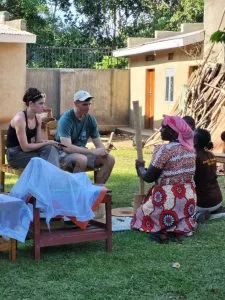
You visit a traditional village settlement where families live in circular mud-and-thatch houses arranged in a protective circle. Here, you experience pastoral life firsthand: you might help with evening cattle herding, participate in milking, or sit with community members as they share stories and teach you phrases in their language.
The Ankole people are warm and welcoming, and conversations often touch on how their traditional way of life intersects with modern Uganda. You learn about marriage customs, initiation rites, the importance of cattle in social structures, and how younger generations are navigating between honoring tradition and accessing modern opportunities.
Day 4: Transfer to Bwindi and Batwa Community Tour
The drive from Lake Mburo to Bwindi takes you deeper into southwestern Uganda, through increasingly mountainous terrain. The landscape becomes greener and more dramatic, with rolling hills, valleys, and the sense that you’re entering a region where human settlement is sparse, and forest dominates.
Bwindi Impenetrable National Park announces itself through dense vegetation and a palpable change in atmosphere. The forest thickens, mist begins to accumulate, and the air grows noticeably cooler and more humid. The name “impenetrable” reflects the forest’s ancient density. This is one of Africa’s oldest rainforests, a habitat of extraordinary biodiversity and the home of nearly half of Africa’s remaining mountain gorillas.
Batwa Community Experience
Before experiencing the gorillas (tomorrow’s main event), you spend the afternoon with the Batwa people – the indigenous hunter-gatherers who have inhabited these forests for millennia. The Batwa have a profound and intimate knowledge of the forest that centuries of habitation have created. They understand the medicinal plants, the animal behaviors, the seasonal rhythms in ways that outsiders can only begin to glimpse.
Your guide – ideally a Batwa person – takes you on a forest walk that’s fundamentally different from a typical nature walk. Rather than looking for specific animals or plants, you’re learning to read the forest the way the Batwa do. Your guide points out medicinal plants and explains their uses: which bark treats which ailment, which roots can be eaten, which plants have spiritual significance. You learn about traditional hunting techniques (though most Batwa have transitioned from hunting due to park regulations), and you begin to understand the depth of ecological knowledge embedded in Batwa culture.
The Batwa people have faced significant marginalization in modern Uganda – displacement from their forest home, social discrimination, limited access to education, and economic opportunities. Yet communities persist, maintaining cultural practices and working toward recognition and rights. Your visit directly supports Batwa-led tourism initiatives, providing income and amplifying their voices.
You likely visit a Batwa settlement where you can interact with community members, perhaps sharing a meal or participating in a traditional dance or music session. Stories emerge: of forest life before national park establishment, of adaptation and resilience, of hopes for their children’s futures.
Day 5: Gorilla Trekking and Transfer to Queen Elizabeth National Park
Long before sunrise, you’re dressed in long pants, closed-toe hiking boots, and layers (the forest is cool and moist). Your guide, a gorilla tracker with years of experience, leads you and a small group into the forest. The darkness is complete until headlamps cut through it, illuminating the trail ahead. The forest is alive with sound: night creatures calling, insects chirping, the rustle of movement in vegetation.
As dawn gradually breaks, the forest reveals itself in incremental shades of green and gray. The air smells of rich earth, growing things, and moisture. You climb steeply through dense vegetation, pushing through vegetation and scrambling over roots. The physical exertion is real – gorilla trekking is hiking at altitude through challenging terrain, but the anticipation drives you forward.
Encounter with the Gorillas
Your guide reads signs invisible to untrained eyes: broken branches indicating recent gorilla passage, feces still warm indicating proximity, and the subtle disturbance of vegetation showing direction of movement. And then a sound. A low vocalization from somewhere ahead. Your guide signals for silence and slow movement.
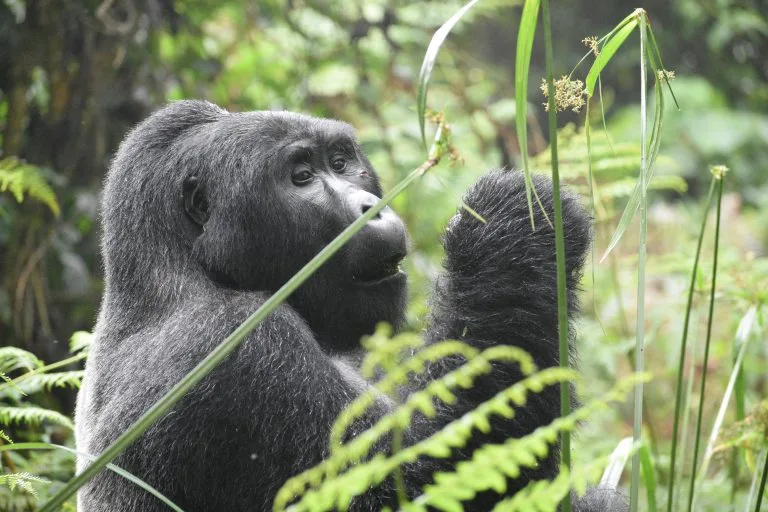
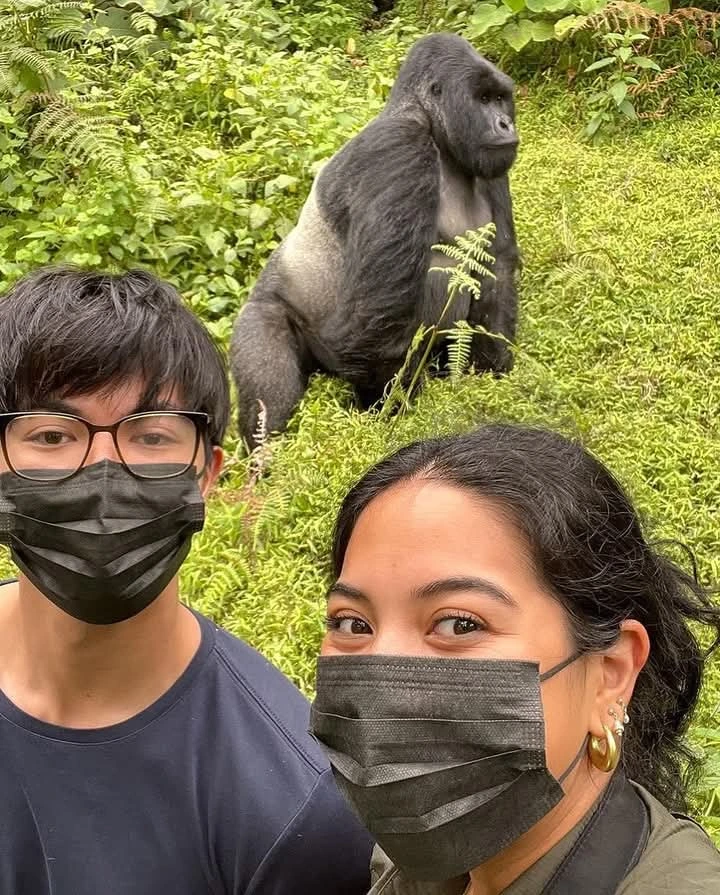
Through the dense vegetation, you first see movement, then shapes, then suddenly gorillas. A family group: a dominant silverback male, females, and offspring. The silverback watches your approach with intelligent eyes, evaluating whether you pose a threat. Your guide positions the group at an appropriate distance, and you have perhaps an hour in the presence of these remarkable beings.
The experience is profound beyond words. The gorillas continue their daily activities, feeding on vegetation, the young ones playing and learning from their mothers, and the silverback maintaining his position within the group hierarchy. You watch a mother groom her infant with gentle hands, observe adolescents wrestling and testing their strength, and see the silverback move with confidence through his territory.
This isn’t a performance. The gorillas largely ignore you, going about their lives in the way they would, whether humans were present or not. And yet your presence here, witnessing this family, understanding their vulnerability, recognizing our kinship with them, creates something transformative. Many people report that encountering mountain gorillas represents a pivotal moment in their relationship with nature and conservation.
The hour passes in what feels like minutes. Your guide signals that it’s time to descend, and you retrace your steps through the forest, carrying the experience with you.
Drive to Queen Elizabeth National Park
After returning to the lodge, refreshing, and having lunch, you drive toward Queen Elizabeth National Park (approximately 4-5 hours). The landscape transitions from montane forest to more open savanna country. Queen Elizabeth, Uganda’s most visited national park, spreads across a vast landscape where wildlife diversity is extraordinary: lions, buffalo, elephants, hippos, multiple primate species, and over 600 bird species.
Day 6: Game Drive and Boat Cruise on Kazinga Channel
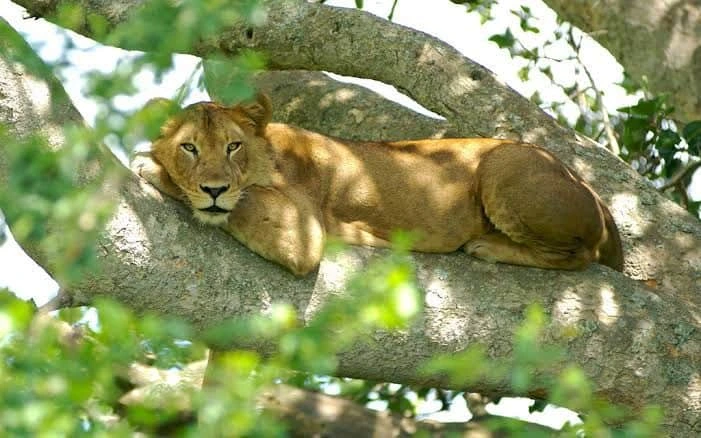
You’re out before sunrise, driving through the park as light gradually returns. Dawn is when wildlife is most active – predators returning from night hunts, prey animals moving to feeding areas, and birds becoming vocal. You see lions resting after a night’s hunting, herds of buffalo grazing, elephants moving through the landscape with deliberate purpose.
Your guide reads animal behavior and tracks: fresh paw prints, scat, identifying which animals passed recently, and the direction of movement, indicating where animals are heading. The game drive isn’t just about sighting animals; it’s about understanding the ecosystem and the complex relationships that bind predator and prey, herbivore and vegetation.
Kazinga Channel Boat Cruise
The Kazinga Channel, a 32-kilometer waterway connecting Lake George to Lake Edward, is Uganda’s most famous wildlife corridor. The channel supports extraordinary concentrations of wildlife, particularly hippos and crocodiles, and provides one of Africa’s most remarkable wildlife viewing experiences.
You board a boat and cruise slowly along the channel. Within minutes, the abundance becomes apparent. Hippos surface everywhere – massive bodies emerging from water, their heads breaking the surface with snorts and bellows. Some are solitary, others in groups, mothers with calves, males establishing dominance. You learn hippo behavior: their territorial nature, their aggression, how they spend days in water, and emerge at night to graze.
Crocodiles line the banks – some basking in the sun, their prehistoric forms seemingly unchanged for millions of years. You see enormous specimens that have survived decades in this landscape, and smaller juveniles learning to hunt. Birds crowd the banks and vegetation: African fish eagles, cormorants, herons of multiple species, and kingfishers diving for fish.
The boat moves slowly, allowing extended viewing. Guides point out behavioral details: a crocodile making a kill, hippos interacting socially, and the complex dynamics of this hyperconcentrated ecosystem. Elephants occasionally come to the channel edge to drink or wade. Buffalo herds gather near water. The density of life here is staggering.
As the afternoon light softens to golden hues, the cruise takes on an almost dreamlike quality. The animals’ reflections shimmer on the water, and the sounds – hippo bellows, bird calls, the water’s gentle lap against the boat – create a sensory experience you’ll carry for years.
Day 7: Transfer to Kibale and Bigodi Community Tour
You depart Queen Elizabeth, driving north toward Kibale National Park (approximately 5-6 hours). The landscape transitions gradually as you move into regions of greater forest cover. Kibale, known as the “primate capital of Uganda,” is home to thirteen primate species – the highest primate diversity of any East African park – and is particularly famous for its chimpanzee populations.
Bigodi Wetland and Community Walk
Rather than diving immediately into forest trekking, you spend your afternoon with the Bigodi community in the Bigodi Wetland Sanctuary, a community-managed conservation area on Kibale’s boundary. This is where conservation and community benefit merge, creating a model where local people directly benefit from forest protection.
You walk through the wetland with a community guide who is likely a resident with intimate knowledge of the area. The wetland is a biodiversity hotspot: you see primates (red colobus monkeys, grey-cheeked mangabeys, various other species), birds of remarkable variety, and the complex plant communities that support wetland ecosystems.
Your guide explains the community’s conservation efforts: how they decided to protect this area rather than convert it to agriculture, how tourism revenue supports local livelihoods, and how younger people are staying in the community rather than migrating to cities. You likely visit community members’ homes, perhaps share a meal, and hear directly about the interplay between conservation and development.
The Bigodi community has become a model for community-based conservation across Uganda. By providing direct economic benefits for forest protection, the community has created incentives for conservation. Simultaneously, community members maintain their cultural practices and continue living in their ancestral landscape.
Day 8: Chimpanzee Tracking and Transfer to Entebbe
The forest is dimly lit, dense with vegetation, and alive with sound. Your tracker moves carefully, pausing frequently to listen. The forest’s layers reveal themselves gradually as light increases: the canopy high above, the mid-story where much life concentrates, the understory in perpetual twilight, the rich forest floor beneath your feet.
A family of chimpanzees becomes visible: adolescents wrestling and playing, females with infants, males moving purposefully. Their intelligence is evident in every gesture. You watch them feed, communicate, interact socially, and move through their world with familiarity and confidence. This encounter – with our closest living relatives, beings with whom we share approximately 98% of our DNA – is often described as profoundly moving. You’re witnessing another consciousness, another society, another way of being in the world.
After the trek, you return to the lodge, have breakfast, and prepare for your drive back to Entebbe (approximately 5-6 hours). The journey takes you back through Uganda’s landscape – from forest to savanna to increasingly urban areas – a geographic and mental transition from wild to civilized.
You arrive in Entebbe in the late afternoon, where your guide drops you at the airport or your accommodation. You have time to rest and reflect on the eight days that have transformed how you understand Africa, wildlife, culture, and your place within the larger web of life. This will mark the end of your 8 Days Uganda Cultural Tour with Uganda’s best Gorilla and safari company, Native Africa Tours.