
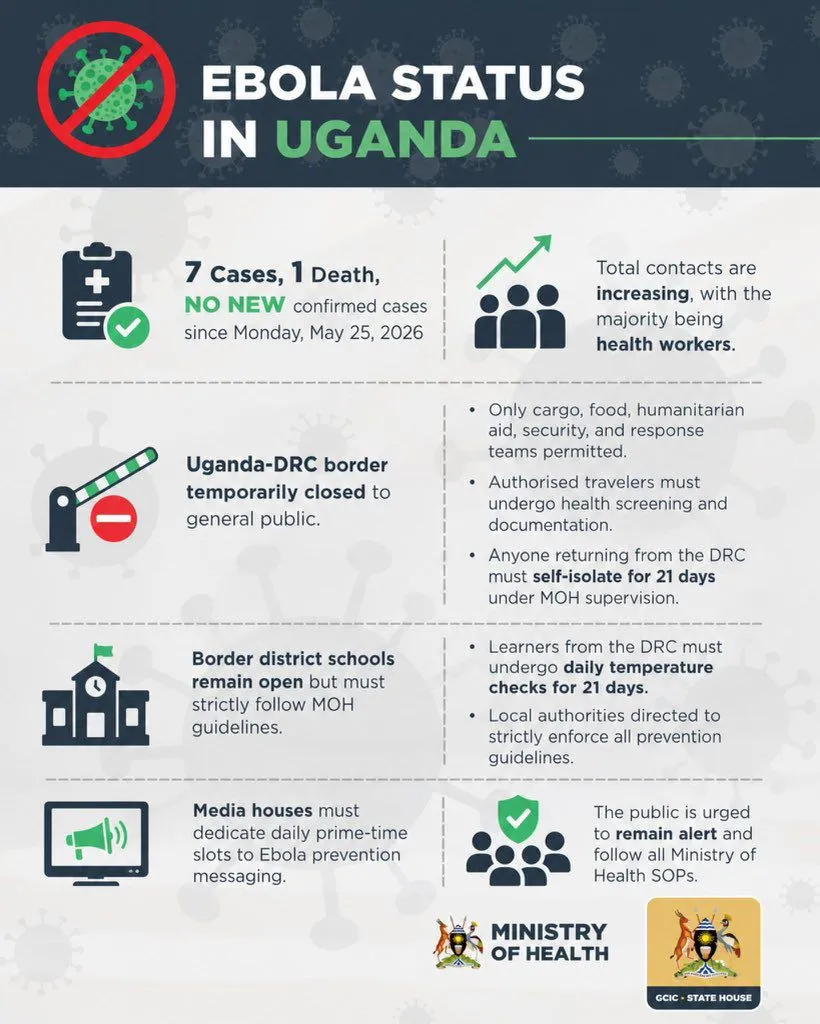
You Should not cancel Your Uganda Safari Plans Despite Ebola Headlines
For any traveler, the decision to book an international trip involves a delicate calculus of time, money, and desire. When you are planning a bucket-list adventure to Uganda – home to the majestic Mountain Gorillas and the thundering Murchison Falls, that decision is usually driven by passion. However, when news alerts flash across screens mentioning an Ebola outbreak in the region, that passion is quickly replaced by a primal, instinctive fear. The knee-jerk reaction is often to cancel, to defer, and to stay home.
While this reaction is understandable, cancelling a Uganda safari solely due to an Ebola outbreak is often a decision made on incomplete information. Uganda is a vast, resilient, and geographically diverse country. The reality on the ground for tourists is vastly different from the sensationalized headlines. If you are on the fence about your upcoming trip, here are the compelling reasons why you should not cancel your Ugandan safari.
Geography is Your Greatest Ally
The first and most practical reason to proceed with your trip is the sheer size of Uganda and the specific geography of the outbreaks. Uganda is approximately the size of the state of Oregon or the United Kingdom. It is a nation of nearly 250,000 square kilometers.
Ebola outbreaks in Uganda, when they occur, are typically highly localized and contained within specific districts. Historically, these outbreaks have happened in central or western regions, often hundreds of kilometers away from the primary tourist attractions. For example, the country’s premier safari destinations – Bwindi Impenetrable National Park, Queen Elizabeth National Park, and Murchison Falls – are often situated 8 to 10 hours by road from the epicenter of an outbreak.
To put this in perspective: cancelling a trip to see the Gorillas in Bwindi because of an Ebola case in a district like Mubende or Kasese would be the equivalent of cancelling a trip to Paris because of a medical emergency in Berlin. The distance, coupled with the rugged terrain and controlled road networks, makes it incredibly difficult for the virus to spread to tourist hubs. The “Uganda” you see on the news as a red zone on a map is not the “Uganda” you will experience as a tourist.
Uganda is a Global Leader in Epidemic Response
It may come as a surprise to some, but Uganda is widely considered one of the world’s most experienced nations when it comes to handling viral hemorrhagic fevers. Unlike the West African outbreak of 2014, which caught countries off guard, Uganda has lived with Ebola sporadically for decades. They have developed a rapid-response mechanism that is the envy of the global health community.
When a case is detected, the Ugandan Ministry of Health, working in tandem with the World Health Organization (WHO) and the Centers for Disease Control and Prevention (CDC), swings into action immediately. They do not wait. Contact tracing is rigorous, isolation zones are established instantly, and ring vaccinations are deployed to protect at-risk populations.
This competence means that an “outbreak” is often contained within weeks or months, rather than years. The government is transparent about reporting cases, which ironically can fuel fear, but this transparency is exactly what keeps tourists safe. By the time your travel dates arrive, the specific incident that caused the news alert may have been resolved and contained, leaving the tourist corridors completely secure.
The Nature of Tourist Activity Limits Exposure
To understand the risk, one must understand how Ebola is transmitted versus how a safari is conducted. Ebola is not an airborne virus like COVID-19 or influenza. It is spread through direct contact with bodily fluids (blood, vomit, feces) of an infected person or animal, or through contact with contaminated surfaces (like bedding or clothing) of a sick person.
Consider the average safari itinerary. Stay in high-end lodges or tented camps that adhere to strict hygiene standards. traverse the savannah in open vehicles, viewing wildlife from a respectful distance. Dine in open-air restaurants. You do not visit crowded hospitals, attend funerals in remote villages, or engage in caregiving for the sick. The cultural and physical distance between a tourist on a safari and the rural communities where Ebola typically strikes is significant.
Furthermore, the tourism industry in Uganda is highly regulated. Gorilla trekking, for example, takes place in controlled environments with health screenings. If a guide or tracker is unwell, they do not work. The protocols in place to protect the Gorillas from human diseases (which serves a dual purpose) create a bubble of safety for the visitors as well.
The Devastating Economic Cost of Cancellation
Beyond the personal loss of your trip, cancelling a safari has severe repercussions for the people of Uganda. Tourism contributes significantly to the GDP and is a vital source of employment for hundreds of thousands of Ugandans.
When travelers cancel, the ripple effect is immediate and harsh. It is not just the international tour operator who loses money; it is the local guide who supports his extended family, the lodge staff who send their children to school, and the farmers who supply produce to the camps. Perhaps most critically, the revenue from tourism funds the conservation of the parks and the salaries of the rangers who protect the wildlife.
If tourism collapses due to fear rather than actual danger, the economic vacuum can lead to increased poverty, which ironically creates an environment where diseases can spread more easily. By traveling, you are injecting vital resources into the healthcare infrastructure (via taxes and park fees) and supporting the very systems that keep the country healthy. Ethical travel in this context means showing solidarity with a nation that is working hard to manage a crisis.
Sensationalism vs. Reality: The Media Gap
The media operates on the adage “if it bleeds, it leads.” A singular case of Ebola in a rural district generates global headlines, while the fact that millions of people are going about their daily lives safely in Kampala, Entebbe, and the national parks rarely makes the news.
Travel advisories issued by foreign governments (such as the US State Department or the UK FCDO) often paint with a broad brush. They may issue a “Reconsider Travel” warning for an entire country based on an incident in a tiny region. However, if you read the fine print, these advisories usually clarify that the risk is confined to specific areas. It is essential to look beyond the headline level of the advisory and understand the nuanced reality. Travelers who have visited Uganda during previous outbreaks frequently report that they felt completely safe and saw no sign of the crisis during their vacation.
The Irreplaceability of the Experience
Finally, consider the opportunity cost. Seeing the Mountain Gorillas in the wild – peering into the eyes of a Silverback as he chews on bamboo – is one of the most profound wildlife experiences on the planet. Uganda is not just a generic safari destination; it is a unique biodiversity hotspot.
Postponing a trip often leads to cancelling it indefinitely. Life gets in the way. Prices go up. The logistics become harder. While safety must always come first, allowing a statistically low-probability risk to rob you of a life-changing dream is a tragedy of a different kind.
A Final Verdict
This is not an article urging you to be reckless. If the outbreak escalates to the point where the WHO advises against international travel or if the specific district you are visiting is the epicenter, then you must cancel. But in the vast majority of cases involving Ebola in Uganda, the situation is a localized medical event that does not impact the tourism circuit.
Uganda is open. The mist is still lifting over the Impenetrable Forest. The Nile is still churning through the rapids. The lions are still lounging in the trees of Ishasha. By travelling, you are not taking an undue risk; you are engaging in a supported, calculated journey to one of the most spectacular places on Earth. Don’t let fear of the unknown steal your adventure. Pack your bags, bring your binoculars, and go see the Pearl of Africa for yourself.