
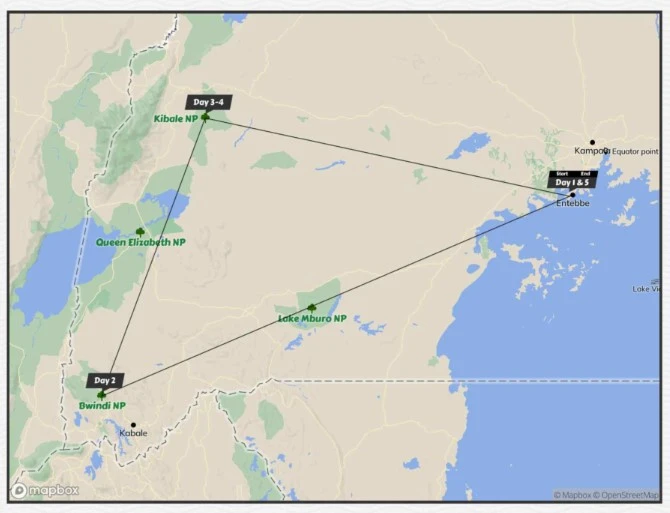
Price of 5 Days Gorilla and Chimpanzee Trekking Safari in Uganda
Planning a gorilla and chimpanzee safari in Uganda is exciting because you get to experience two of the most famous primate encounters on Earth. These are: mountain gorillas in Bwindi Impenetrable National Park (and sometimes Mgahinga) and chimpanzees in primate-rich forests such as Kibale National Park. Many travellers also like that these activities can be combined into a single trip. A 5 days Uganda Gorilla and Chimpanzee Trekking Safari itinerary is often the sweet spot for travellers who want both experiences without spending too many days on the road.
That said, one of the first questions people ask is always the same: How much does a 5 days gorilla and chimpanzee trekking safari cost in Uganda? The answer is not just one number. Uganda safari pricing is driven by a combination of fixed government permit fees and variable package costs set by tour operators for transport, accommodation, meals, and guiding services. Once you understand those two parts, you can budget more confidently and compare quotes more fairly.
This article explains how pricing works, what costs you should expect, and what factors can make the total safari price rise or fall, so you know whether a quote is good value or overpriced.

The Permits Required
The most important starting point for pricing is that gorilla trekking and chimp trekking require permits. In most cases, these permits are issued by the Uganda Wildlife Authority and are required for every visitor. This means that even if two safari operators have different travel styles and lodge categories, the permit component is usually similar.
Gorilla trekking permit cost
For foreign non-residents, the standard gorilla trekking permit is commonly priced at USD 800 per person. This permit is what allows you to enter the gorilla habitat with guided trekking rules and then spend a limited time observing a habituated gorilla family. The permit fee also contributes to gorilla conservation, ranger operations, and community conservation support.
Chimpanzee trekking permit cost
For foreign non-residents, the chimpanzee trekking permit, most commonly for Kibale National Park, is priced at USD 300 per person. Like gorilla trekking, chimp trekking involves trained trackers and strict rules meant to protect the primates and reduce disease transmission risk. The permit covers ranger support, tracking, and the official costs associated with running the activity.
Permit subtotal for a 5-day “gorilla and chimps” safari
If your itinerary includes one gorilla trek and one chimp trek, then the permit subtotal is typically USD 1,100 per person. For many travellers, this is the number they see repeated in quotes. It is also the number that helps you quickly estimate the minimum cost of the trip before adding lodge, transport, and services.
Why the Total Safari Price Can Still Vary a Lot
After you pay for permits, the remaining portion of the safari price comes from package costs that vary from one operator to another. Two safari packages can both include the same permit fees but end up with very different totals.
Transport and Uganda’s distance realities
Uganda’s major gorilla and chimp trekking areas are not next door to each other. A 5-day itinerary typically includes at least one long transfer day. The chimp area (often Kibale) and the gorilla area (primarily Bwindi) are far enough apart that the safari vehicle and driver time are a major cost driver. Because gorilla and chimp treks are weather- and schedule-sensitive, operators also try to manage timing carefully. Good scheduling reduces stress and improves the likelihood that you actually complete the treks smoothly.
Accommodation category and location
Accommodation can range from basic to high-comfort lodges. Since a 5 days Uganda Gorilla and Chimpanzee Trekking Safari itinerary usually includes about 4 nights, lodging quality becomes a big part of the total price.
Meals and inclusion level
Some safari packages include all meals (often described as full board). Others may include fewer meals or require you to pay for some meals separately. Meal inclusions affect price directly because they change how much the operator spends daily on your behalf.
Guiding and operational support
Even though you physically trek only on specific days, your safari still requires guides, ranger coordination, and day-to-day operational management. The operator’s staffing and service model can influence cost. Premium operators may offer more staff involvement and higher service standards.
Standard Trekking vs Habituation
When you compare quotes, make sure you are comparing the same type of experience. Many travellers assume “gorilla trekking” always means the same thing, but that is not always true in Uganda’s product categories. Gorilla Habituation options usually cost more because the experience is typically longer and more intensive, and it requires additional ranger support and scheduling complexity. If a quote seems significantly higher than other quotes, this is one of the first things to check.
Typical 5 Days Uganda Gorilla and Chimpanzee Trekking Safari Itinerary Structure
Understanding the typical itinerary helps you understand why costs add up. A common pattern for a 5-day Uganda gorilla and chimp safari is;
- Day 1: Arrival and travel to the chimp area (often Kibale region)
- Day 2: Chimpanzee trekking in Kibale
- Day 3: Transfer to Bwindi (gorilla region)
- Day 4: Gorilla trekking in Bwindi
- Day 5: Return journey toward Kampala/Entebbe
Because transfers take time, your lodging nights are mostly determined by where you need to sleep before each trek day. If your operator arranges the route efficiently and chooses lodge locations well, you may feel less rushed. If the routing is less efficient, the trip can feel more tiring even if the total price is similar.
What to Check Before You Pay
When comparing quotes, don’t only look at the total price. A “cheaper” safari may actually cost more later if it excludes meals, includes the wrong type of permit, or uses a less convenient lodge schedule that increases travel stress. Ask your operator these key questions:
- Does the total price include both permits (gorilla and chimp)?
- Are they standard trekking permits or habituation permits?
- What is the accommodation category, and is it comfortable for your needs?
- Are meals included (and which ones)?
- Is transport shared or private?
- How many nights are included, and where are those nights located?
- What happens if road conditions delay the transfer?
A reliable operator should answer clearly and provide a detailed breakdown of inclusions.
How to Choose the Best Value, Not Just the Cheapest Quote
Gorilla trekking and chimp tracking are expensive experiences because the encounter is limited and carefully managed. Because of that, the “cheapest” quote is sometimes not the best choice. A slightly higher price may include better lodge locations, smoother transfers, and more reliable service, things that directly affect your enjoyment, energy, and safety.
The best value is usually found by comparing quotes that include the same type of permits, the same trek style, and similar accommodation tiers. Once you compare on equal terms, price becomes easier to judge fairly.
Final Budget Takeaway
A 5 days gorilla and chimpanzee trekking safari in Uganda usually starts with permit costs that total about USD 1,100 per person (commonly USD 800 for gorillas and USD 300 for chimps). The remainder of the cost comes from accommodation, transport, meals, and guiding services. For most travellers, a realistic planning range is:
- USD 2,000 – USD 2,600 for value/budget safaris,
- USD 2,600 – USD 3,800 for mid-range safaris,
- USD 3,800 – USD 6,000+ for premium/private safaris.