
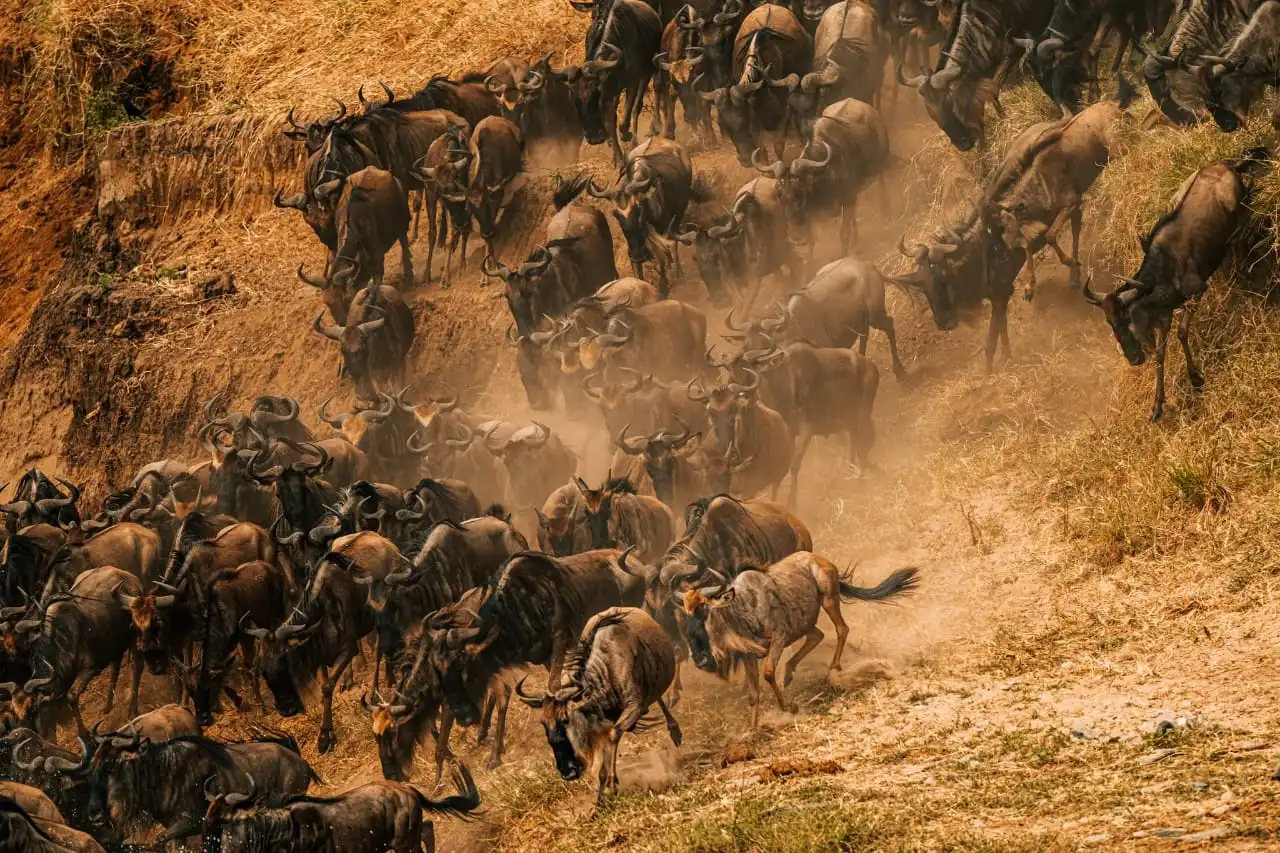
Wildebeest Migration in November – Where the Herds Are and What to Expect
Is November a good month for wildebeest migration? November presents an excellent opportunity to witness the wildebeest migration in the Serengeti National Park. Embarking on the wildebeest migration in November allows you to witness large crowds of wildebeests as they cross back to the Ndutu Conservation Area. Watching wildebeest as they cross the river once again can be mesmerizing. Wildebeests cross to the Ndutu region primarily to catch up with the calving or birthing season.
These dramatic gatherings set the stage for the next chapter of the migration. Wildebeests gather in large numbers as they prepare for the onset of the short rains. After a short while, the herds start moving to search for the green grazing spots in the Serengeti’s Southern sector. The population of predators also increases, including lions, leopards, and others. Predator activity intensifies, with a higher possibility of catching a glimpse of several of them in the wild.
The November River Crossing
Whereas the dramatic Mara River crossing often occurs around early July, there is another chance to witness the Grumeti and Mara river crossing in November. In November, wildebeests begin moving to the south. Before you start on a tour, please make sure that you have timed your vacation to avoid getting there at the right time.
Wildebeests on the Move in November
Zebras and wildebeest become more active again in November, with most of them crossing back, and others settle at the Seronera and Lobo Valley Regions. The demand for the nutritious grasses increases with extensive columns of the wildebeest concentrating along the Central Serengeti.
Rainy Season
Serengeti records random rains from November to March, but this only happens for a short period. After a few hours, the rain showers can stop. Towards the end of November, Serengeti experiences light rains with the majority of the wildebeests drifting to the southern Serengeti.
There is still a chance to watch large herds as they cross the river. The large concentration of these fascinating mammals is seen in the Kogatende and Lamai.
Expectations for the Migration Safari in November
November marks the beginning of the light rains. The migration drifts mainly to the Southern Serengeti and Northern Ngorongoro Conservation Area. It is around November when most safari lodges also cut down on the cost of their accommodation services.
The prime spots to explore on the wildebeest migration in November include the Lobo, Seronera Valley, and Mbuze Mawe. Wildebeests are spotted in large numbers in the Serengeti Valley, and later, they begin migrating to the Southern section to search for fresh pastures.
Captivating game viewing in November– Rains usually occur in the afternoon, which lets you experience the best morning game drive and birding.
Birding in the Serengeti is a perfect opportunity for enthusiastic birders to identify their favorite birds. Birds in Serengeti include common waxbill, hammerkop, Kori bustard, painted snipe, African fish eagle, ostriches, green-winged teal, Northern shovelers, African pygmy-goose, Maccoa ducks, cape teal, Northern pintail, white-bellied bustard, and chestnut-bellied sandgrouse.
Other birds include Klaas’s cuckoo, great spotted cuckoos, African cuckoos, African emerald cuckoos, black coucal, spotted thick-knee, African fin foot, Senegal lapwing, little ringed plovers, black-bellied plovers, brown-chested lapwing, blacksmith lapwing, eastern yellow-billed hornbills, southern ground hornbill, Eurasian hoopoe, Von der Decken’s hornbill, and standard scimitar bill, etc.
Where to See the Herds in November
Serengeti offers the mesmerizing wildebeest encounters, and around November, the special locations to consider a must to explore include the North-eastern Serengeti, Mbuze Mawe, and Seronera Valley.
The Seronera is Serengeti’s iconic wildlife spot. The highest concentration of wildebeest, along with many other grazers, can be excellently witnessed in Seronera. By November, the large herds of these mammals are attracted to the regions with more palatable grass. Due to the vast abundance of grazers, even predator activity increases, allowing you to catch a glimpse of several prides of prominent cat families. Seronera offers unmatched game drive experiences, and as you traverse the vast plains, you have abundant wildlife to encounter.
As a core of the vast Serengeti protected area, visitors don’t need to worry about places to stay. Seronera features luxurious lodges and camps, making it a convenient spot to start your vacation in the Serengeti National Park.
Mbuze Mawe lies in the extreme northeastern part of the scenic Serengeti and in proximity to the Ngorongoro. It is a perfect place to find wildebeests. The Mbuze Mawe region lies along the Serengeti migration route to the Ndutu region.
The Northeastern region, comprising mainly the Lobo region, is an excellent location to visit for witnessing wildebeest in November. Here, you can witness wildebeest take a counter-clockwise movement. They cross the Mara en route to Kenya and return via the Serengeti’s Lobo area. To witness this magical movement, you should book your lodge or camp in the Lobo region.
Where to Stay on a November Serengeti Safari
Visitors can opt for a safari lodge or camp. You can choose a camp/lodge near the wildebeest migration spot. It should be easier for you to connect from the lodge or camp to the point of watching the wildebeests. Top accommodation options include Nasikia’s Kaskaz, Lemala’s Kuria Hills Luxurious Camp, Lamai Serengeti Camp, Asilia Olakira Camp, Dunia Camp, Singita Mara River Tented Camp, and Four Seasons Lodge.
The Masai Mara Migration in November
The great migration begins to move southwards from the Masai Mara into the Serengeti. The wildebeest herds head to the Loliondo region by November. Loliondo Game Controlled Area is an extensive wildlife-protected area, endowed with biodiversity, and is valuable to the Serengeti-Mara ecosystem.
However, to experience the dramatic Mara River crossing (Kenya), July to October are the best months of the year. These are the dry months when tourists can witness huge herds of wildebeests, gazelles, and zebras actively shifting into the Masai Mara. Visitors have a higher chance of watching the powerful river crossings at the Mara River than in November.
Masai Mara National Reserve is one of the best game viewing reserves in East Africa and covers 1510 sq. km, and is an ideal destination to encounter not just the wildebeests but also the elephant, leopards, lions, cape buffaloes, rhinos, and many antelope families. The antelopes to expect to find here include dik-dik, waterbucks, hartebeests, and topis, and other mammals like hyenas, jackals, wild dogs, mongoose, and many others.
About 450 bird species are also distributed in the various habitats including little grebe, ostriches, goliath heron, African darters, spotted thick-knee, wood sandpipers, blacksmith lapwing, African jacanas, yellow-rumped tinker birds, banded martin, Fischer’s sparrow-lark, Nubian woodpeckers, Rupell’s vultures, Egyptian vultures, African pied wagtail, martial eagle, helmeted Guineafowl, Southern ground hornbill, and many more.
The Safari Lodges or Camps to Stay in and around the Masai Mara
The lodges and camps present for overnight stay in and around Maasai Mara include Mara Sweet Acacia, Richard’s River Camp, Little Governor’s Camp, Mahali Mzuri, Basecamp Wilderness, Rhino Tourist Camp, Mara Chui Camp, Basecamp Adventure, Fig Tree Camp, Simba Oryx Camp, Mara Bush House, Porini Lion Camp, Sentrim Mara Camp, Ol Moran Tented Camp, Sala’s Camp, and others.
Conclusively, wildebeest migration in November promises magical encounters of its own. To gain a deeper insight into the Serengeti-Mara migration in November, consider booking a trip with an expert. Contact your trusted expert now, Native Africa Tour to book a memorable migration vacation of a lifetime.