Combining Gorilla Trekking with a Classic African Safari
For the discerning traveller, Africa is a continent of duality. It is a land where the ancient rhythms of the wild clash and merge with the vibrant pulse of modern culture. When planning a luxury or adventure safari to East Africa, a common dilemma arises: should one pursue the intimate, soul-stirring encounter with the Mountain Gorillas in the mist, or opt for the sprawling, cinematic savanna experience populated by the Big Five? The answer, for those with the time and the means, is not to choose, but to combine Gorilla Trekking with a classic African safari.
Merging a gorilla trekking expedition with a traditional savanna safari creates the ultimate African itinerary. It offers a study in contrasts – moving from the steamy, impenetrable rainforests of the Virunga massif to the golden, sun-drenched plains of the Serengeti or Queen Elizabeth. This juxtaposition elevates the journey from a mere wildlife viewing trip into a profound exploration of the continent’s diverse ecological tapestry. To undertake both is to witness the full spectrum of life on the continent, from the dense jungle to the endless horizon.

The Anatomy of the Itinerary
Geographically, the most convenient way to combine these experiences is through Uganda and Rwanda. Both nations boast the volcanic highlands that are home to the endangered Mountain Gorillas, yet both offer remarkably different, world-class savanna safari options just a few hours’ drive or a short flight away.
In Uganda, the combination of Gorilla trekking and a wildlife safari is seamless. A traveller can fly into Entebbe and drive south-west to Bwindi Impenetrable National Park or Mgahinga Gorilla National Park. After the emotional high of the trek, the journey naturally continues to Queen Elizabeth National Park. Located merely a few hours north of Bwindi, Queen Elizabeth offers a classic safari experience with vast herds of elephants, buffalo, and the famous tree-climbing lions of the Ishasha sector. Alternatively, one can fly north to Murchison Falls National Park for a starkly different landscape of rolling grasslands and the powerful Nile River.
In Rwanda, the itinerary is even more compact. A trek in the Volcanoes National Park in the north can be perfectly paired with a safari in Akagera National Park in the east. While Akagera is younger in its conservation revival, it is a stunning reserve of savanna, hills, and lakes, now home to the reintroduced black rhino and lion. For those willing to cross borders, a short flight from Kigali connects directly to the vast Serengeti ecosystem in Tanzania or the Maasai Mara in Kenya, making Rwanda a logistical hub for the ultimate “mountain-to-beach” or “jungle-to-plains” trajectory.
The Gorilla Encounter
The first half of this dual experience is defined by intensity and intimacy. Gorilla trekking is distinct from almost any other wildlife activity on Earth. It is not a passive viewing from the safety of a vehicle; it is an immersive, physical engagement with the environment.
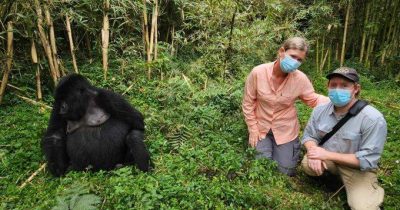
The trek begins in the early morning mist, often shrouded in fog that clings to the volcanic slopes. You are on foot, hacking through dense undergrowth, slipping on red mud, and navigating steep ridges. The air is heavy with the scent of damp earth and decaying vegetation. The physical exertion serves as a build-up, a purging of the modern world’s noise. When you finally encounter the gorillas, the distance is often measured in meters, not miles.
To look into the brown eyes of a Silverback, to watch a mother groom her infant, or to feel the ground vibrate as a 200-kilogram male chest-beats, is a deeply humanising experience. It is a quiet, humbling interaction. The hour spent with them feels fleeting, leaving an indelible mark on the soul.
The Savanna Experience
Transitioning from the jungle to the savanna is a shift in sensory perception. If the gorilla trek is a close-up portrait, the savanna safari is a wide-angle landscape masterpiece.
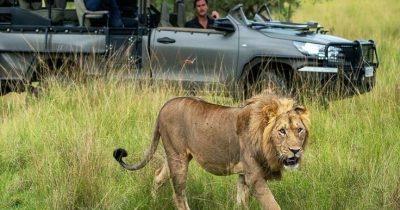
Suddenly, the oppressive walls of the forest give way to 360-degree horizons. The air becomes dry and warm, filled with dust and the scent of sun-scorched grass. Here, the mode of transport changes. You are now in a 4×4 Land Cruiser, the roof popped open, scanning the endless plains.
The savanna offers volume and velocity. Instead of tracking one family of primates, you are witness to thousands of wildebeest and zebra migrating, herds of elephants dusting themselves at waterholes, and prides of lions lounging in the shade of acacia trees. The dynamic here is predator and prey, the eternal cycle of life and death played out in the open. It is dramatic, loud, and expansive. After the claustrophobic intimacy of the rainforest, the savanna feels like a release—a breath of fresh air.
Logistical Considerations and Pacing
While the combination is rewarding, it requires careful logistical planning. The physical demands of gorilla trekking should not be underestimated. It is arguably the most strenuous activity on a standard safari itinerary.
Therefore, the rhythm of the trip is crucial. Most experts recommend doing the gorilla trek first, or at least ensuring there is a rest day between the trek and the long travel to the savanna park. After hiking steep volcanoes for 4 to 8 hours, your body will appreciate the relative passivity of a game drive.
Travellers should also pack for two different climates. For the gorillas, you need waterproof hiking boots, long trousers, gardening gloves (for stinging nettles), and a rain jacket. For the savanna, you need neutral-colored lightweight clothing, a wide-brimmed hat, and plenty of sunscreen. The “safari green” and “khaki” wardrobes serve very different masters.
Cost is another factor. Gorilla trekking permits are expensive, currently $800 in Uganda and $1,500 in Rwanda. A savanna safari is generally more cost-effective per day, depending on the level of luxury. However, viewing these two experiences as a package helps rationalise the investment; you are covering the two most iconic wildlife buckets on the continent in a single trip.
Pack Your Bags and Go.
The ultimate reward of combining these two experiences is the completeness of the narrative. You arrive as a traveller, but you leave as a storyteller. You can speak of the silence of the rainforest, broken only by the crunch of a gorilla eating celery, and in the same breath, describe the thunderous roar of a lion across the Serengeti plains at sunset.
It is a journey that captures the heart of Africa: its mystery and its majesty; its claustrophobic life and its boundless freedom. To see the Mountain Gorilla is to connect with our ancient ancestry; to see the Elephant and Lion on the savanna is to witness the raw power of nature. By combining Gorilla trekking with an African safari, you don’t just see animals, you see the world in all its beautiful, chaotic complexity. For anyone looking to maximise their time in East Africa, this dual itinerary is not just a recommendation; it is the gold standard.