Mgahinga and Mutanda Tours
In the southwestern corner of Uganda, where the earth seems to rear up to touch the sky, lies a travel experience that is as dramatic as it is intimate. While the world flocks to the dense, humid forests of Bwindi Impenetrable National Park to pay homage to the mountain gorilla, a quieter, more geologically spectacular alternative awaits the discerning traveler. This is the realm of Mgahinga Gorilla National Park and the serenely beautiful Lake Mutanda. Combining tours to Mgahinga Gorilla National Park with a stay on Lake Mutanda offers a safari that is not just about wildlife, but about the soul-stirring grandeur of Africa’s landscape.
Mgahinga Region and Its Beauty
Mgahinga Gorilla National Park is Uganda’s smallest national park. Howver what it lacks in size is more than makes up for in drama. It is part of the larger Virunga Conservation Area. This straddles the borders of Uganda, Rwanda, and the Democratic Republic of Congo. The park is dominated by three extinct, conical volcanoes: Muhabura, Gahinga, and Sabyinyo. These ancient giants provide a breathtaking backdrop, their peaks often shrouded in a veil of mist that shifts and swirls with the changing winds.
The park’s slogan is “Where Gold meets Silver,” referring to its two main primate inhabitants: the Golden Monkey and the Silverback Gorilla. While the Golden Monkeys are a delightful, endangered species found only in the Virungas, the mountain gorillas remain the crown jewel. Mgahinga is home to one habituated gorilla family, the Nyakagezi group.
For a long time, this family was known for their wanderlust, frequently crossing borders into Rwanda and the DRC, making them unreliable for tourists. However, in recent years, the Nyakagezi group has settled comfortably within the Ugandan borders. This has turned Mgahinga into an exclusive destination. Unlike Bwindi, where multiple permits are sold daily across many sectors, Mgahinga offers a more limited, private encounter. You are not one of many; you are a guest in a very specific, very wild home.
Bamboo and Breathlessness in Mgahinga
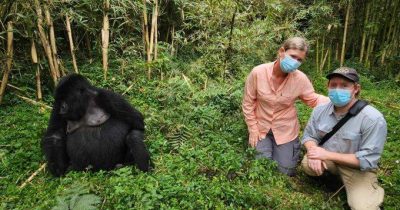
Trekking in Mgahinga is a distinct experience compared to Bwindi. The terrain here is defined by bamboo forests. As you ascend the slopes of the volcanoes, you walk through a cathedral of green bamboo stalks that clack softly in the breeze. The undergrowth is generally less dense than in Bwindi, meaning the hiking can feel slightly less “impenetrable,” though the altitude, ranging from 2,227m to 4,127m, ensures that it is still a physical challenge.
The hike is a sensory journey. The air is crisp and cool, smelling of damp earth and vegetation. As you climb, your guide hacks a path through the vegetation, communicating with the trackers who have located the family earlier that morning. The anticipation builds with every ascent.
When you finally find the Nyakagezi group, the setting is often theatrical. Because of the open nature of the bamboo forest, photography can sometimes be easier here, with natural light filtering through the canopy. The family is led by the dominant Silverback, Mark, a powerful yet calm presence. Watching him interact with his offspring, or watching the younger gorillas wrestle and swing from the bamboo stalks, is a profound reminder of our shared ancestry. The hour spent with them feels like a suspension of time. This time is a rare privilege to observe a family unit in the wild, unbothered by the world below.
The Batwa Heritage
No visit to Mgahinga is complete without encountering the Batwa people, the indigenous forest dwellers who were the original inhabitants of this high-altitude jungle. For generations, they lived as hunter-gatherers, their lives intertwined with the ecosystem. When the park was gazetted for conservation, they were moved out of the forest.
Today, the Batwa Cultural Trail offers a moving glimpse into their ancient way of life. Led by Batwa guides, you walk through the forest they once called home. They demonstrate how they used plants for medicine and build grass huts. They also show they hunted with bows and arrows. The Batwa Guides take visitors into the sacred Garama Cave, a lava tube beneath the mountain. This was once a council chamber and a refuge. The tour culminates in a hauntingly beautiful performance of music and dance in the cave. It is a poignant reminder of the cost of conservation and the resilience of the human spirit.
Lake Mutanda
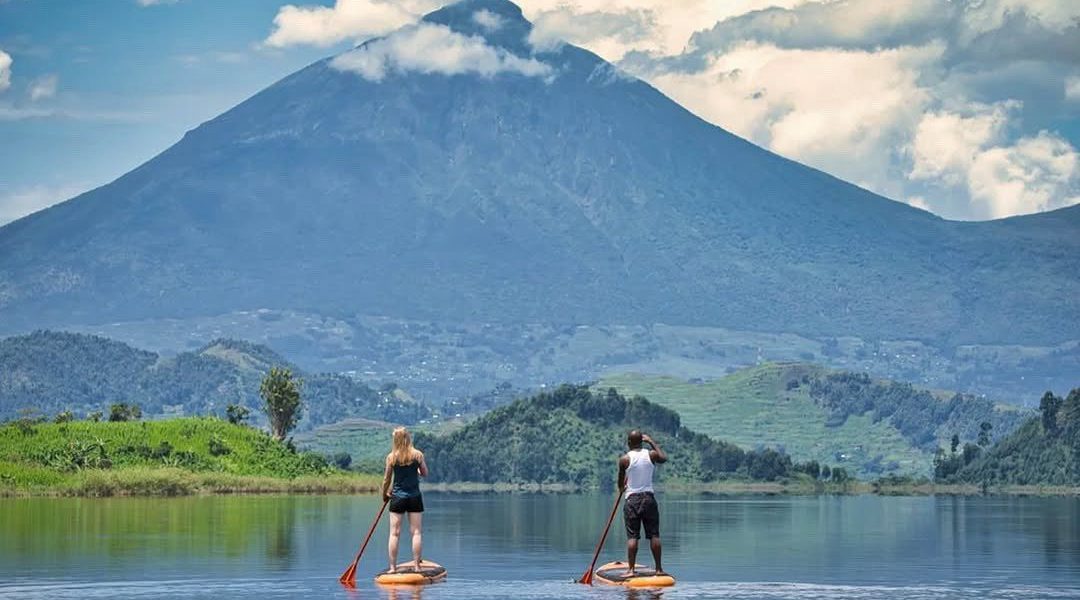
After the adrenaline and exertion of the trek, the transition to Lake Mutanda is a descent into paradise. Located just a 45-minute drive from Mgahinga, Lake Mutanda is a scenic wonderland. It is a freshwater lake nestled in the foothills of the Virunga volcanoes, dotted with a series of jagged islands and surrounded by lush, terraced Kigezi highlands.
If the volcano is the drama, Lake Mutanda is the romance. The atmosphere here is palpably slower. The lake is often referred to as the “Switzerland of Africa” due to its rolling green hills and pristine waters, but the comparison falls short of the unique African magic that permeates the air.
Staying on the shores of Lake Mutanda offers a chance to decompress. The lodges here, such as the eco-friendly Lake Mutanda Resort or the charming Chameleon Hill Lodge, are designed to blend seamlessly with the environment. Waking up here is a spiritual experience. The mist rises off the water like steam, revealing the silhouette of the volcanoes across the bay. The air is filled with the chatter of birdlife. The lake is a haven for waterbirds, including the majestic crested crane and various species of kingfishers.
The Lake Experience
A safari here is about more than just looking; it is about engaging. A canoe ride on Lake Mutanda is a highlight. Traditional dugout canoes, paddled by local guides, glide silently over the water. As you float towards the islands, you pass locals fishing in traditional dugouts, tossing their nets out with rhythmic precision.
You can paddle to the Punishment Island, a tiny islet with a dark history. This is where unmarried pregnant girls were once abandoned, a stark contrast to its peaceful present-day beauty. The lake is also free of bilharzia and hippos in the immediate swimming areas. This make it one of the few places in East Africa where you can take a refreshing dip with safety.
For the more active guests, the lake serves as a base for hiking the surrounding hills. You can also visit the nearby permaculture farms that supply the lodges. However, for many, the greatest joy is simply sitting on a deck with a cup of Ugandan coffee or a gin and tonic, watching the sun dip behind the volcanoes. As the sky turns from azure to violet to deep indigo, the lights from the fishermen’s boats twinkle on the water like fallen stars. It is a moment of profound peace.
Combining Mgahinga and Lake Mutanda Tours
Combining tours to Mgahinga and Lake Mutanda creates the perfect balance. Mgahinga provides the adventure, the physical challenge, and the raw emotional encounter with the gorillas. It is the high-octane, awe-inspiring peak of the trip. Lake Mutanda provides the sanctuary. It is the place to process the experience, to rest tired muscles, and to absorb the beauty of the landscape at a gentler pace.
This itinerary appeals to the traveler who seeks the authentic and the extraordinary. It avoids the crowds of Bwindi and the busier tourist circuits. The package offers a chance to see the “Silverback” in the bamboo forest and the “Golden” reflection of the sun on the lake. It is a journey that takes you from the roof of Africa to the water’s edge. This reveales the diverse and breathtaking beauty of Uganda’s southwest. In the shadow of the Virungas, amidst the mist and the water, you find a corner of Africa that feels entirely, wonderfully your own.