

Great Wildebeest Migration in the Maasai Mara
The Great Wildebeest Migration in the Maasai Mara remains at the top of the list of Kenya’s main safari experiences. Wildebeest migration features as the world’s second most significant overland migration, with wildebeests and other grazers embarking on a trek of over 800km. The Great Migration attracts over 1.5-2.5 million wildebeests plus zebras, gazelles, and other animals. The most spectacular part of the Great Wildebeest Migration in the Masai Mara is the Mara River Crossing.
Wildebeests cross from Serengeti National Park to Maasai Mara National Reserve. They connect to the Maasai Mara through the Mara River, a river known for its huge concentrations of Nile crocodiles. Wildebeest herds often follow a clockwise migration pattern between the Serengeti and Masai Mara ecosystems.
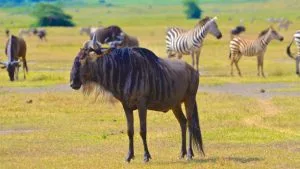
Witnessing the Powerful Mara River Crossing
The Mara River crossing offers the most dramatic experience. Watching millions of wildebeests as they manoeuvre through the Mara River, one of East Africa’s densely populated crocodile rivers, leaves lasting memories. It is a unique story to tell, observing these mammals as they jump after being attacked, and when they finally make it to the mainland, it is indeed a great success for them.
You can miss something else, but not the River crossing in the Maasai Mara National Reserve. Once thousands of wildebeests cross to the mainland, they encounter several predators, including lions and leopards. The wildebeest’s journey to regions with palatable pasture tends to be more challenging and dramatic. You’ll need to prepare your camera with extra batteries and storage because a lot is going on.
Best time to witness the Great Migration in the Maasai Mara
The Great Migration in the Maasai Mara takes a unique cycle, but July to September offer exceptional encounters. If your target is the Mara River crossing, could you consider booking your migration safari between July and September? These months provide the peak wildebeest migration experience in the Masai Mara Reserve.
Follow the Great Migration by Months
The Great Migration doesn’t occur only once a year; it follows a cycle. Each event unfolds exceptional encounters, but the river crossing marks the climax of it all.
The Great Migration from December to April
From December to April, the wildebeest herds concentrate on the Southern Serengeti National Park. They dominate the Ndutu Plains and the Ngorongoro region. The four months offer exceptional encounters with the wildebeests, with the key highlight being the calving event. Observing the wildebeest as they give birth can be mesmerising. Vast herds of wildebeest are confined in the region, though the event occurs amid many challenges from predators. The calves often remain vulnerable to the predators. Towards the end of March and the start of April, wildebeest herds set off with their young ones, taking the northward route. The majority of the wildebeest would have already left and would be confined in the central and western Serengeti National Park.
May-June
Between May and June, wildebeest move northwards to search for fresh pasture and water to drink. Vast columns of these mammals can be spotted joined by several Grant’s & Thomson’s gazelles, plus zebras. By around June, the rains would have ended, and the normal Grumeti River crossing would commence. The Grumeti River crossing depends on the water level. Tanzania’s River crossing may not offer the dramatic crossings of the Mara River, but it is something to look out for during a Great Migration safari.
July to September
The powerful Mara River crossing occurs between July and September. If wildebeest migration is your target, then embarking on a Kenya tour to the Masai Mara from July to September should be a must-do. Once they have crossed, most wildebeests can be seen foraging in the green grassy areas. This happens before they move to the North to occupy areas like Olare Orok and Mara North Conservancies.
The Migration from October-November
The Great Migration heads south, navigating through the Western Loliondo and Lobo areas. They return to the lush green areas, and you can sight them from October to November in Kogatende and Lamai. November usually records shorter rainfall cycles, and some wildebeest herds concentrate in the Lobo, Seronera Valley, and Mbuze Mawe. It is around this time that these three regions in Serengeti National Park feature abundant pasture and water.
Insights into the Maasai Mara Reserve and Wildebeests
The Masai Mara Reserve, also known as the Maasai Mara/Mara National Reserve, is a popular wildlife safari destination in Kenya. The reserve is situated in the extreme Northwest of Kenya, Narok County.
The Masai Mara covers 1510 sq. km and features a breathtaking landscape characterised by acacia trees, grasslands, and meandering rivers, including the Talek and Mara rivers. During the wildebeest migration tour, visitors get a chance to see more than wildebeests. The reserve is home to other wildlife, which you can safely spot during the guided game viewing trip.
Additional wildlife to see on a game viewing tour in the Masai Mara includes the Big 5 (buffaloes, leopards, lions, rhinos, and elephants), jackals, cheetahs, crocodiles, hyenas, hippos, gazelles, and giraffes.
This reserve also protects a total of about 500 bird species, including the saddle-billed storks, little grebe, long-tailed cormorants, common ostriches, goliath herons, African darters, Meyer’s parrots, white-browed coucals, verreaux’s eagle-owl, Schawlow’s turacos, black-chested snake eagle, hooded vultures, and lilac-breasted rollers.
Beyond the Great Migration Experience
The Masai Mara National Reserve offers a myriad of other exciting activities besides witnessing the Great Migration. They include horseback riding, guided walking safaris and nature treks, guided game drives, hot air balloon tours, and cultural visits to the Maasai Mara.
Safari Lodges and Camps to Stay during the Great Migration in the Masai Mara
Choose the right places for an overnight stay during the Great wildebeest migration. Here are the top accommodation options to consider as you plan your vacation to experience the Masai Mara’s Great Migration: Olakira Migration Camp, Tayari Luxury Tented Camp, Mara Serena Safari Lodge, Masai Mara Sopa Lodge, Mahali Mzuri Luxury Lodge, and Fig Tree Camp.
Maasai Mara also features accommodation options such as Sarova Mara Game Camp, Porini Lion Camp, Mara Bush House, Kichwa, Little Governors’ Camp, Nyota Mara Lodge, AA Mara Lodge, Marriott Masai Mara Lodge, and AndBeyond Bateleur Camp.
How do I get to the Masai Mara Reserve?
When you plan your visit to the Masai Mara, please consider your connectivity to the reserve. Visitors can access the Maasai Mara by road or by air. By road, expect a 5-6 hour drive from Nairobi City to reach the Masai Mara. Or take a short flight, and in just 60 minutes, you can be in the Maasai Mara Reserve.
The access gates to the Masai Mara Reserve in Kenya include Musiara, Sekenani, Oloololo, and Sand River gates. The airstrips to land at in the Masai Mara include Ol Seki Airstrip, Serena, Siena, Kichwa Tembo Airstrip, Keekorok Airstrip, and others.
Conclusively, book a trip to Kenya with Native Africa Tours and experience the Great Wildebeest Migration in the Maasai Mara National Reserve. The wildebeest migration safari experience presents a unique chance for you to witness millions of wildebeests accompanied by other grazers as they search for water and pasture. The Great Migration tours can also be combined with hot-air balloon safaris, game drives, horseback riding, and nature/bushwalking experiences.