
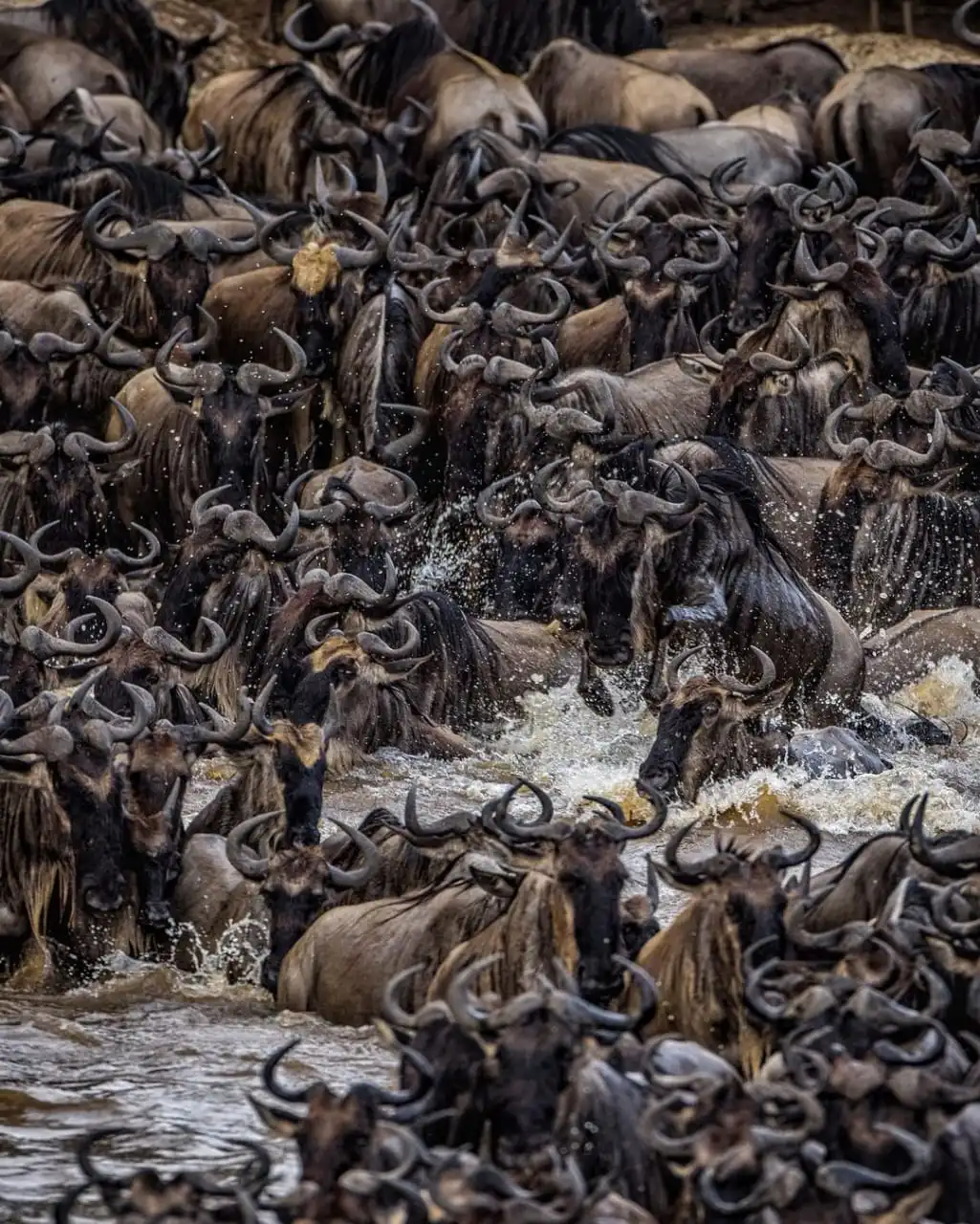
Wildebeest Migration in August: Mara River Crossings and Safari Highlights
Wildebeest migration in August offers an exceptional opportunity for you to be part of the dramatic wilderness experience in the African wilderness. August is part of the peak season for tourists to enjoy the excellent views of the wildebeest, zebras, and other grazers. It is in August when visitors get a chance to witness large herds of the wildebeests as they cross from the plains of the Serengeti to the Masai Mara.
Thousands of wildebeests traverse the Serengeti plains in search of fresh pastures, creating one of nature’s most stunning events. They embark on a perilous journey as predators dominate their route. Predators such as cheetahs, leopards, lions, and crocodiles patiently wait in hiding to strike these mammals. The sheer scale and intensity of this world’s spectacle can be breathtaking, with astonishing wildlife sightings guaranteed.

The Great Migration & other Wildlife in the Masai Mara
Around August, the great migration concentrates in the lush Masai Mara plains and the Northern Serengeti. The Masai Mara National Reserve is best visited in August for you to witness the dramatic Mara River crossings. During the peak wildebeest migration, such as August, over 1.5 million wildebeests embark on the powerful trek in the savannas of the Masai Mara, which occurs every July through October.
The Masai Mara Reserve is situated in southwestern Kenya with an area coverage of 1510 sq. km. The reserve’s landscape is composed mainly of the gently rolling African savanna plains. A diverse array of wildlife awaits you to encounter, including zebras, giraffes, cheetahs, leopards, Cape buffaloes, elephants, hyenas, and over 450 bird species.
The Masai Mara was fully recognised as a Reserve in 1961. And its landscape is vast savanna grassland, rolling hills, the Talek, and the Mara River. A variety of bird species also reside in the Mara Reserve, including hottentot teal, red-billed teal, spur-winged goose, white-faced whistling-duck, Egyptian Goose, secretary birds, storks, hammerkop, dwarf bitterns, rufous-bellied heron, cattle egrets, ostriches, temminck’s courser, three-banded courser, and black-winged stilt.
Witnessing the Wildebeest Migration in the Serengeti in August
Around August, wildebeest herds drift north from the Serengeti to the Masai Mara. The focal points to witness this world’s spectacle include the Northern Serengeti and the Mara River in Kenya. By August, herds would have moved from the western corridor to escape the dry spell and look for fresh pasture.
The Serengeti National Park is an extensive protected area in Tanzania, covering an area of 14,763 sq. km. Serengeti is a designated UNESCO World Heritage Site and is found in the eastern Mara region. It is most popular for its massive annual wildebeest migration, with the most mesmerising being the Grumeti River crossing. Watching wildebeest cross this marshy western corridor’s crocodile-infested river leaves lasting memories.
Serengeti holds the world’s largest migration and also features other diverse wildlife. It is a complete big five game destination (home to the Cape buffalo, rhinos, elephants, leopards, and lions), and other mammals such as giraffes, warthogs, gazelles, and a total of about 500 birds.
Birds of interest in the Serengeti include the African fish eagle, superb starling, secretary bird, lilac-breasted rollers, Kori bustards, vulturine guineafowl, ostriches, Fischer’s lovebird, yellow-throated sandgrouse, Southern ground hornbill, Schawlow’s wheatear, and many others.
The August Weather and Climatic Conditions.
The Serengeti National Park and the Masai Mara experience a long dry season in August, but some rain showers can be recorded. Temperatures fluctuate, with daytime highs reaching 26 degrees Celsius and nighttime lows at 14 degrees Celsius. Rainfall in the Serengeti can be experienced for about 6 days, with minimal precipitation of 19 mm.
Accommodation to Stay During the Great Migration in August
Choose your accommodation options wisely with guidance from the experienced local tour operator. Pick the right accommodation option from the available budget, midrange, or luxury. When booking the lodges to stay, consider the options that are located in the reserve or park and shouldn’t be far from where the Great Migration is to be witnessed.
The lodges and camps should be booked in advance. The available choices of accommodation for your overnight stay in August include Sayari Mara Camp, Olakira Camp, Mara River Mobile Camps, and Mara Serena Safari Lodge. Other lodges include Miti-Minigi Eco Camp, Fairmont Mara Safari Club, Four Seasons Safari Lodge Serengeti, Greenwood Safari Camp, Base Camp Masai Mara, Talek Bush Camp, and others.
Tips for Planning the Great Migration in August
To plan a successful migration safari in August, here are some of the essential tips to guide you;
When and Where
Timing shouldn’t be ignored if you plan to witness the Great Migration in August. The dry or peak time for the wildebeest migration extends up to August, and it is possible to observe the Mara River crossing. Huge herds of wildebeests cross from Tanzania’s Serengeti to Kenya’s Masai Mara, amidst hungry crocodiles.
Book your Migration Vacation in Advance
Early reservation is essential for a memorable trip, and being the peak month, it can help you secure the slot in advance and decide where to stay. The demand often hikes up when it is a peak migration season like August. It can be competitive to secure the Migration slot and accommodation options in Masai Mara. This is why we suggest you begin the planning stages ahead of time.
Consider Alternatives Like Mobile Camps.
If you don’t find the exact lodge option, don’t hesitate to take the next available one. You can also take up the mobile camps. The mobile camps offer an exceptional opportunity for you to witness the migration and other wildlife in a better way than if you remained in the fixed lodges or camps.
Embark on a Migration with a Guide.
To enjoy the services of a professional guide, please feel free to book your trip in advance. Guides have schedules, and early planning can enable our company to assign the best driver guide to you. We don’t pick any random guide to take you on a memorable migration safari, but rather the experienced, trusted, and professional driver guide.
Always be Patient
To experience most of the river crossings (such as the Grumeti or Mara River), some patience is required. The wildebeest migration is one of the most unpredictable events and is often influenced by the presence of lush green pasture.
Try to Pack Smart for Your Trip.
Carry only the essentials for your Mara River crossing and game viewing in the Masai Mara or Serengeti National Park. On your packing list, the following shouldn’t be missed: long-sleeved shirts, a first aid kit, sunscreen, binoculars, a daypack, a sweater, a camera, comfortable trousers, a bottle of drinking water, and bottled water. When selecting the proper safari attire, be mindful of the environment and weather. Environmentally friendly clothes should be a must-have because they blend more seamlessly with nature.
Respect wildlife and set regulations.
All the protected areas have set regulations. Failure to observe the park rules may lead to extra costs to meet the penalties.
Conclusively, book your wildebeest migration in August to experience the most dramatic wildlife experience. Start the conversation early to plan an unmatched migration experience by contacting Kenya’s most reliable tour operator, Native Africa Tours.