
Wildebeest Migration in June: Western Serengeti and Grumeti River Safaris
June is one of the best months of the year to witness the Great wildebeest migration in Kenya and Tanzania. The wildebeest migration in June is when the large wildebeest herds migrate quickly to Kenya to search for greener pastures. It marks the arrival of the wildebeest herds and marks the start of the peak migration, making it an excellent month for observing diverse wildlife. Wildebeest herds start to drift from the Serengeti, and by June, a massive profusion of these mammals is present, with several of them widely available in the vast plains.
The migration stays in the Maasai Mara from September to October, providing remarkable opportunities to witness large herds of antelopes accompanied by zebras. By mid-June, the extensive Masai Mara plains are home to massive wildebeest herds. Being the peak dry season, it is also possible to observe other wildlife, given the short vegetation cover and the enormous concentration of most wildlife at the few water sources in the reserve.
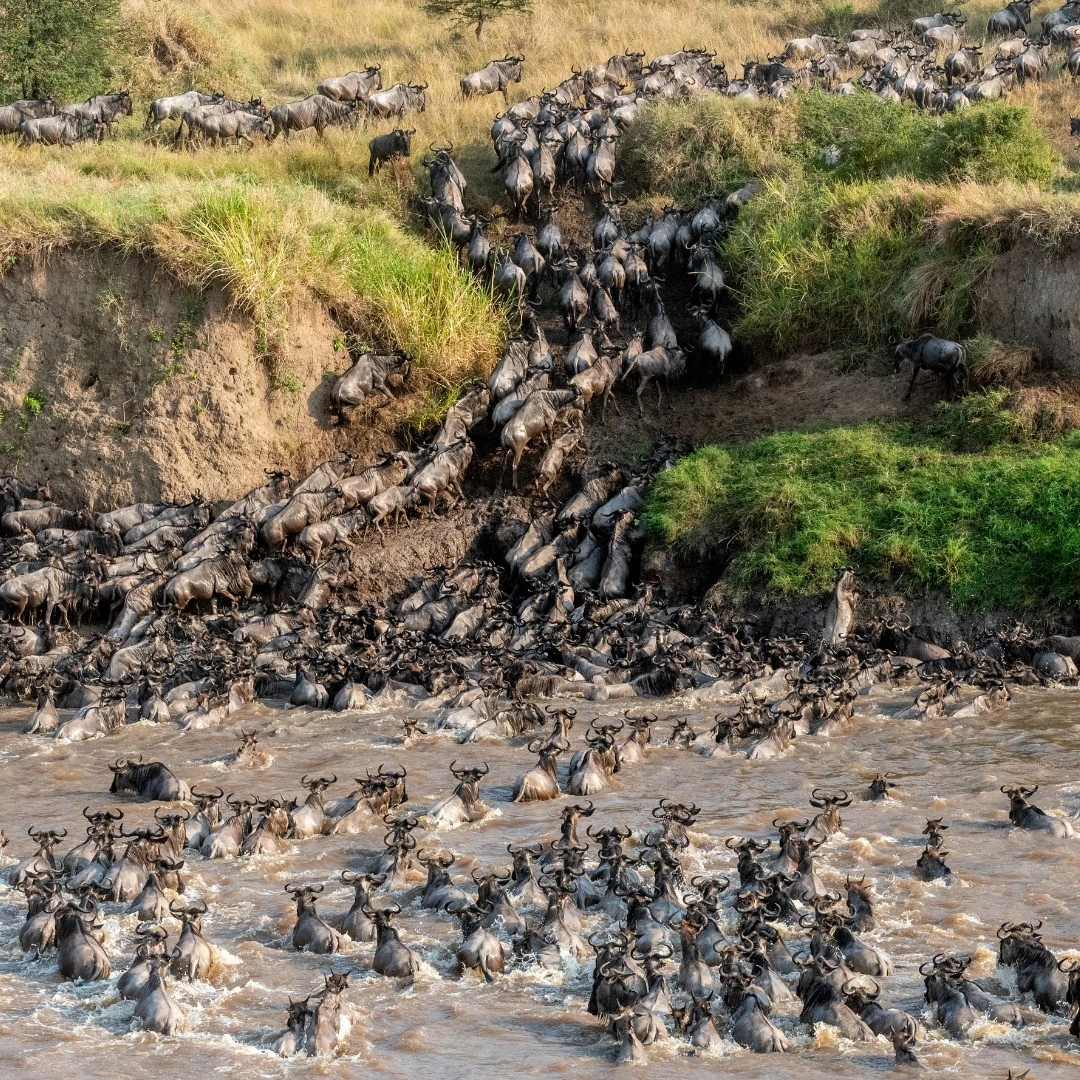
In Tanzania, the large herds of wildebeest migrate to the Western Corridor of the Serengeti to feed on the abundant grasses. June typically marks the first major crossing of the Grumeti River, amid a massive concentration of crocodiles.
Weather in June
June is characterised by a long dry season. The transition from the long rainy month of May comes with pleasant temperatures and pasture. Temperatures and rainfall often decrease with long hours of daylight. June offers incredible conditions for game viewers to witness their favourite wild animals. From May to July, the Serengeti experiences its lowest temperatures, which are about 25 degrees Celsius. Around June, rains are received with regular precipitation of about 23mm. Daytime temperatures vary from 26 degrees Celsius to 14.3 degrees Celsius at night.
The Masai Mara experiences warm weather conditions in June, which favour game viewing. During the daytime, temperatures rise to 25 degrees Celsius, while at night, they drop to 10 degrees Celsius.
Where to Find the Wildebeest Herds in June?
Around June, the wildebeest migration mainly concentrates in the Western Corridor of the Serengeti, drifting west and North in search of palatable pasture and water. The wildebeest often cross the Grumeti River around the same period. The exact location of the Great Migration is determined by rainfall and the presence of pasture. Availability of pasture and water attracts massive columns of wildebeest together with gazelles and zebras that concentrate in the Serengeti’s Central-Western plains.
A significant population of the wildebeests starts to drift northwards to the Mara River. While the Mara River is the focal point of the African migration, the dramatic river crossing is best observed in July and August. This is the period when large herds can be witnessed drifting from the Serengeti to the Masai Mara in Kenya. June is mainly rewarded with the mesmerising Grumeti River crossing in the Serengeti. The Grumeti River crossing occurs first before the prime Mara River crossings.
Why Book the Wildebeest Migration in June?
Experience intense Wildlife Encounters in the Serengeti-Mara ecosystem.
June is an excellent month for experiencing a more intimate wildlife encounter than any other month. Huge concentrations of wildlife congregate around the limited water sources, guaranteeing captivating predator sightings and other wild animals. The vegetation remains shorter, allowing tourists to encounter a range of their favourite animals in the vast plains of the Mara Reserve and Serengeti.
The diverse predators to witness during the wildebeest migration in June include leopards, lions, cheetahs, and more.
Dramatic River Crossing
June is an incredible month for you to experience the first main river crossings, particularly at the Grumeti River. The epic Grumeti River crossing allows you to witness not only wildebeests and other grazers, but also large Nile crocodiles.
Ideal Weather Conditions for Game Viewing in the Savanna Plains
Suppose you want to enjoy mesmerising game viewing in Kenya’s and Tanzania’s vast plains. In that case, June should be your travel month to book a trip—the Maasai Mara and Serengeti experience favourable weather conditions, guaranteeing incredible game viewing excursions.
The Rich Masai Mara Ecosystem
The Maasai Mara lies in Southwestern Kenya and features vast African savanna plains. The reserve measures 1510 sq. km in area, lying at the border with the Serengeti National Park. The Mara Reserve is an exceptional wildlife conservancy area, home to not only the Great Migration but also other abundant wildlife, making it a premier destination to witness a diverse array of wild animals.
Besides wildebeests, the Maasai Mara protects a diverse range of wildlife, including rhinos, elephants, giraffes, Cape buffaloes, zebras, cheetahs, and numerous antelope species. An additional checklist of antelope families to find in the vast plains of the Masai Mara includes the common elands, Grant’s gazelles, Beisa Oryx, Coke’s hartebeests, impalas, bushbucks, and roan antelopes.
Birds: More than 500 species of birds make the Masai Mara a vital bird area and an excellent destination to find diverse savanna avifauna. The myriad birds to identify on the Maasai Mara tour include the grey heron, Kori bustards, secretary birds, saddle-billed storks, goliath herons, Ross’s turacos, Madagascar squacco, Schawlow’s turacos, superb starling, and many migratory species. Birding in the Masai Mara is excellent around April and October.
Where to Stay on a Safari in the Maasai Mara
The accommodation options in the Masai Mara are widespread in and around the reserve. The popular lodge options inside the reserve include the Keekorok Lodge, Mara Serena Safari Lodge, Little Governor’s Camp, and Sarova Mara Camp. Other unique accommodation options include Richard’s Forest Camp, Mara Ngenche Camp, Basecamp Explorer Masai Mara, Angama Mara, Elewana Sand River Mara, Fig Tree Camp, and Zebra River Camp.
Getting to the Masai Mara for a Vacation in June
Set off from Nairobi to the Maasai Mara, a journey that takes between 6 and 7 hours. A 4×4 safari vehicle is ideal for your Masai Mara road trip. By air, take a domestic flight from Wilson Airport to the airstrips present in the Masai Mara, including the Mara North and Ol Kiombo Airstrips.
Explore the Wonders of the Serengeti Beyond the Wildebeest Migration.
The Serengeti National Park is spectacularly situated in the northern circuit of Tanzania, the country’s premier game-viewing destination. This park spans over 14,763 square kilometres of the area, primarily comprising vast savanna plains. It harbours a vast array of predators and other herbivorous animals. On a safari, expect to witness wildlife other than wildebeests, including giraffes, elephants, cheetahs, leopards, gazelles, hyenas, hippos, crocodiles, elands, and more.
Over 500 species of birds also exist in varying habitats of the Serengeti, including the common waxbill, Kori bustards, superb starling, African fish eagle, ostriches, flamingos, lilac-breasted rollers, secretary birds, African wattled lapwing, African jacanas, and goliath herons. At the Serengeti, the primary habitats for finding a diverse range of birds include acacia woodlands, wetlands, riverine zones, and open savanna plains.
Accommodation Options
Top places to stay on migration safari in Serengeti in June include the AndBeyond Grumeti Serengeti River Lodge, Faru Faru Lodge, Mawe Tented Camp, Serengeti Pioneer Camp, Serengeti Serena Safari Lodge, Melia Serengeti Lodge, Awali Serengeti Camp, and Olakira Migration Camp. You can also book Four Seasons, Lemala Ewanjan Tented Camp, Singita, Dunia Camp, and Mbugani Migration Camp.
Getting to Serengeti in Tanzania
Road and air transportation are the two convenient options available for travelling safely to the Serengeti National Park. By road, expect to drive for 6-7 hours; a 4×4 vehicle is recommended for this route. By air, you can take short flights from Arusha to the Seronera, Sasakwa Airstrips, Grumeti, and Ndutu Airstrips.
How to Witness the Great Migration in June
To experience the wildebeest migration in June, you should book your vacation with Native Africa Tours. To witness this world’s spectacle, consider embarking on a game drive and hot air balloon tour, with a focus centred on the Western Corridor, Grumeti, and Mara Rivers.
Conclusively, the wildebeest migration safari in June lets you experience both the Serengeti and Mara wildebeest and other grazers. Want to experience both Tanzania and Kenya migration? Then book your June wildebeest migration vacation with Native Africa Tours.